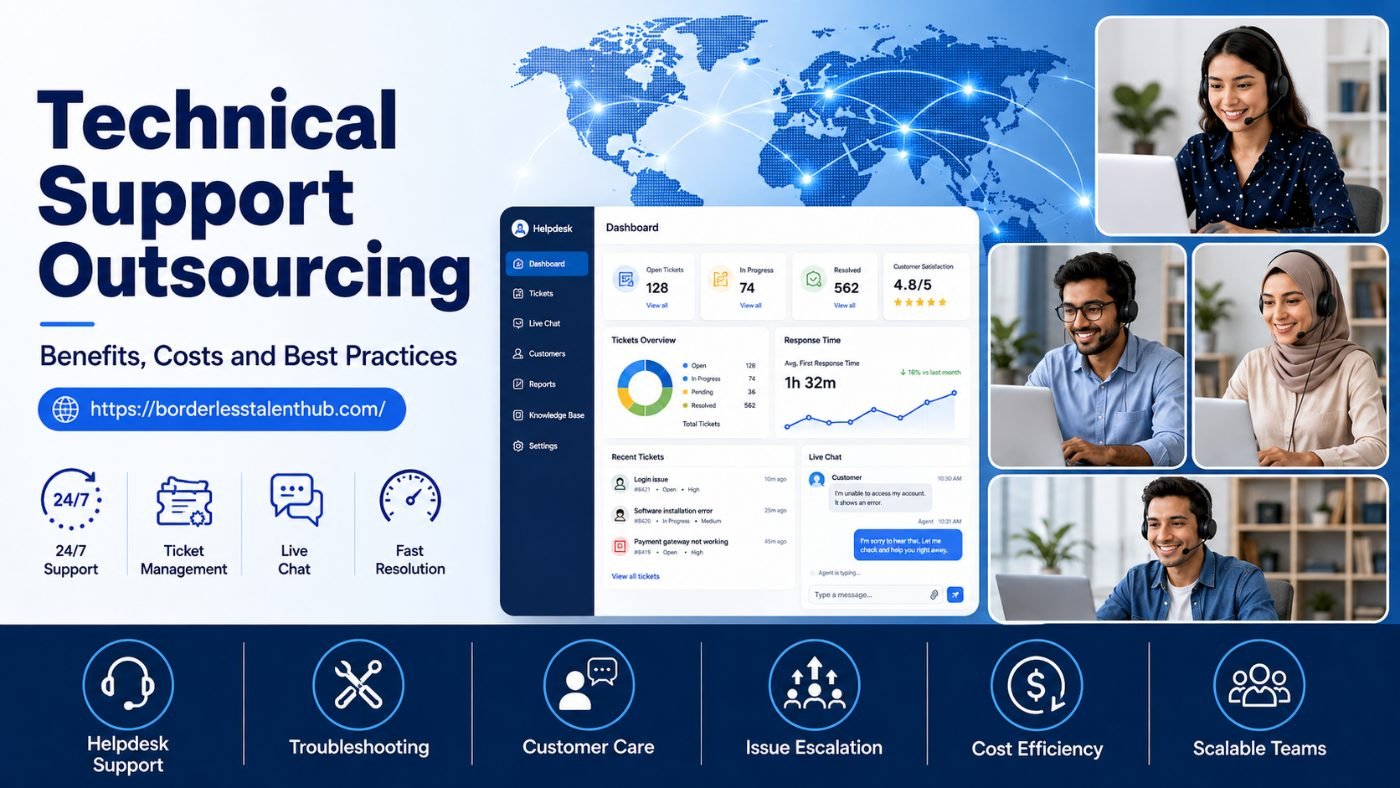
Technical Support Outsourcing: Benefits, Costs and Best Practices
Technical support is one of the most important customer-facing functions in a modern business. Whether a company sells software, digital services, e-commerce products, professional tools, online platforms, subscriptions, devices, or business services, customers expect quick, helpful and reliable support when something goes wrong.
For businesses in Europe, the USA, Canada, Australia and New Zealand, building an in-house technical support team can be expensive and time-consuming. Hiring locally may be difficult, service demand may change throughout the year, and internal teams may already be stretched across product, operations, sales, customer success and administration.
This is why many companies now consider technical support outsourcing.
Technical support outsourcing allows a business to use remote specialists or dedicated support teams to handle helpdesk requests, troubleshooting, live chat, email support, customer queries, ticket management, technical documentation, product guidance and escalation support. When managed properly, it can improve response times, reduce internal workload, support customers across time zones and give the business a more scalable service operation.
Borderless Talent Hub helps businesses hire remote specialists, build dedicated teams and manage global workforce operations through recruitment, onboarding, payroll coordination, EOR support and ongoing account support. You can explore the full service model here: Services | Borderless Talent Hub.
What is technical support outsourcing
Technical support outsourcing is the process of using external remote talent, a dedicated support specialist or a managed team to help customers, users or internal staff resolve technical issues.
This can include support for:
- Software platforms
- Mobile apps
- E-commerce systems
- Website issues
- Customer portals
- Digital products
- CRM or helpdesk tools
- Account access problems
- Product setup and onboarding
- Troubleshooting common errors
- Internal IT or operations workflows
- Customer service linked to technical queries
The outsourced support team may work as the first point of contact, helping customers with common issues, or as a more specialist layer that handles technical troubleshooting and escalation.
For many growing businesses, outsourcing works best when the remote team is integrated into the company’s existing systems, brand tone, support processes and reporting structure.
What does outsourced technical support include
Technical support outsourcing can be tailored depending on the business, product, service level, customer volume and technical complexity.
1. Helpdesk and ticket management
A remote technical support specialist can help manage incoming support tickets through your chosen helpdesk platform.
This may include:
- Reviewing new tickets
- Categorising customer issues
- Responding to common technical questions
- Assigning priority levels
- Updating ticket statuses
- Escalating complex cases
- Closing resolved tickets
- Maintaining ticket notes and histories
Good ticket management helps prevent customer queries from being missed, duplicated or left unresolved.
2. Live chat and email support
Many customers prefer quick support through live chat or email.
Outsourced technical support can cover:
- Product guidance
- Login and access queries
- Basic troubleshooting
- Setup instructions
- Order or account-related technical issues
- Feature explanations
- Follow-up communication
- Issue resolution updates
This is especially useful for businesses that receive regular support enquiries but do not have enough internal capacity to respond quickly.
3. First-line technical troubleshooting
First-line support handles common and repeatable technical issues.
Examples may include:
- Password resets
- Account setup
- Browser or device guidance
- Basic product configuration
- Error message explanations
- Step-by-step troubleshooting
- User onboarding queries
- Common platform problems
A well-trained first-line team can resolve many issues before they reach developers, engineers or senior managers.
4. Escalation support
Not every problem can be solved at first contact.
Outsourced technical support should include a clear escalation process for:
- Complex technical bugs
- Security-related concerns
- Payment or account access issues
- Product faults
- Repeated complaints
- Urgent service failures
- Issues requiring developer review
- High-value client cases
The remote support team should know when to resolve, when to ask for more information and when to escalate internally.
5. Knowledge base and documentation support
Technical support teams often see the same questions again and again.
A remote support specialist can help build or update:
- FAQs
- Help articles
- Troubleshooting guides
- Internal support notes
- Customer onboarding instructions
- Standard response templates
- Product process documents
- Escalation guides
This improves support consistency and reduces the number of repeated queries over time.
6. Customer onboarding support
For software, platforms, subscriptions and technical services, onboarding is often the stage where customers need the most help.
Outsourced support can assist with:
- Welcome emails
- Setup guidance
- Account activation
- Walkthrough instructions
- Basic training calls
- Follow-up after sign-up
- User questions during early use
- Collecting feedback from new users
A smoother onboarding experience can improve customer satisfaction and reduce early cancellations.
7. Reporting and service performance tracking
Technical support should be measured, not guessed.
Useful reports may include:
- Number of tickets received
- Average first response time
- Average resolution time
- Common issue categories
- Customer satisfaction feedback
- Escalation volume
- Repeated technical problems
- Support workload by channel
- Support performance by shift or team member
This helps the business understand where customers struggle and where product, process or documentation improvements are needed.
Benefits of technical support outsourcing
1. Faster response times
Customers often judge a business by how quickly it responds when something goes wrong.
Outsourcing can give your business more support coverage, especially during busy periods, evenings, weekends or different time zones.
A dedicated remote support specialist can help reduce waiting times and keep the support queue moving.
2. Lower internal workload
Without a support structure, technical questions often end up with founders, managers, developers or operations staff.
This can distract internal teams from higher-value work.
Technical support outsourcing allows internal teams to focus on product improvements, client strategy, sales, operations and delivery while trained support staff handle repeatable customer issues.
3. Better customer experience
Customers want clear answers, not long delays or confusing handovers.
A structured outsourced support team can improve the customer experience by providing:
- Clear communication
- Consistent responses
- Better follow-up
- More organised ticket handling
- Faster issue triage
- Helpful documentation
- Professional escalation
Good support builds trust and helps customers feel that the business is reliable.
4. Flexible service coverage
Technical support demand can rise and fall.
A business may need more support during:
- Product launches
- Seasonal peaks
- Marketing campaigns
- New platform releases
- Customer onboarding periods
- Software migrations
- Service updates
- Expansion into new countries
Outsourcing gives businesses a more flexible way to add capacity without immediately building a large local team.
5. Access to remote technical talent
Technical support roles require a mix of skills: communication, patience, process discipline, product understanding and problem-solving.
Remote hiring gives businesses access to a wider talent pool and can make it easier to find people who fit the role, tools and service hours required.
Borderless Talent Hub’s process includes role scoping, sourcing, screening, onboarding support, payroll coordination and ongoing support depending on the selected model. You can see the process here: How Global Hiring Works | Borderless Talent Hub.
6. Improved knowledge base and support systems
A good outsourced support team does more than answer tickets.
Over time, they can help identify:
- Repeated customer questions
- Confusing product steps
- Missing help articles
- Weak onboarding points
- Common user mistakes
- Support bottlenecks
- Product improvement opportunities
This information can help the business improve both customer support and the product experience.
7. Cost-effective scaling
Hiring a full local support team can be costly, especially when demand is still growing.
Technical support outsourcing can give businesses a more cost-effective way to start with one remote specialist, then scale into a larger team as the support volume increases.
Borderless Talent Hub lists customer support specialists from £999/month, with pricing depending on role type, seniority, market and support model. You can compare options here: Global Hiring Pricing | Borderless Talent Hub.
How much does technical support outsourcing cost
The cost of technical support outsourcing depends on the role, level of technical skill, working hours, country of hire, support channels, tools, management requirements and whether additional payroll or compliance support is required.
Common cost factors include:
- Part-time or full-time support
- First-line or specialist technical support
- Email, chat, phone or helpdesk coverage
- Number of support hours required
- Time zone coverage
- Product complexity
- Training requirements
- Helpdesk and CRM tools
- Reporting needs
- Quality assurance requirements
- EOR, payroll or compliance support
- Whether one person or a team is required
A basic helpdesk support role may cost less than a specialist product support role. A full-time remote technical support specialist may cost more than part-time ticket handling support. A 24-hour or multi-time-zone support model will usually require a wider team.
The key is to calculate the full support model, not just the monthly salary.
Technical support outsourcing cost checklist
Before choosing a support model, ask:
- Do we need email, live chat, phone support, or all three
- Is the role first-line support or more technical troubleshooting
- How many hours of coverage do we need each week
- Which time zones must be covered
- What tools will the remote support team use
- How much product training is required
- Who will handle escalations
- What service levels do we want to achieve
- Do we need payroll, EOR or compliance support
- Can the role scale into a wider support team later
This helps businesses choose a support model that fits both service needs and budget.
Best practices for technical support outsourcing
1. Define the support scope clearly
Before hiring a remote technical support specialist, define exactly what the role should cover.
A strong scope should include:
- Support channels
- Working hours
- Ticket types
- Response expectations
- Escalation rules
- Tools and systems
- Customer tone of voice
- Reporting requirements
- Product training requirements
- Security and data handling rules
Clear scope prevents confusion and helps the remote team understand what they are responsible for.
2. Document common support issues
Outsourced support works best when common questions and fixes are documented.
Useful documents include:
- Product overview
- Troubleshooting guide
- FAQs
- Support scripts
- Escalation matrix
- Login and access process
- Refund or cancellation rules
- Customer communication templates
- Internal notes on sensitive issues
Documentation helps the support team give consistent answers and reduces the need to ask internal staff the same questions repeatedly.
3. Train the team properly
Technical support specialists need more than a login and a task list.
Good onboarding should include:
- Product walkthrough
- Common customer problems
- Demonstration of support tools
- Brand tone guidance
- Ticket handling process
- Escalation examples
- Data protection rules
- Role-play or sample tickets
- Quality review expectations
- First-week check-ins
The better the training, the faster the remote specialist can become productive.
4. Use a clear escalation process
Escalation is one of the most important parts of technical support.
The team should know:
- Which issues they can resolve alone
- Which issues need manager review
- Which issues require technical team input
- Which cases are urgent
- How to record escalation notes
- How to update the customer during delays
- Who owns the final resolution
This avoids customer frustration and keeps complex issues moving.
5. Set service level expectations
Service levels help measure support quality.
Your business may set targets for:
- First response time
- Resolution time
- Ticket backlog
- Customer satisfaction
- Escalation rate
- Reopened tickets
- Live chat response time
- Follow-up completion
These targets should be realistic for the team size and support hours.
6. Keep customer communication human and clear
Technical support can become frustrating if the customer receives robotic or unclear replies.
Support communication should be:
- Polite
- Clear
- Helpful
- Honest
- Step-by-step where needed
- Free from unnecessary jargon
- Focused on the customer’s issue
- Updated regularly if resolution takes time
Outsourced support should still feel like part of your brand.
7. Protect customer data and system access
Technical support teams may handle customer information, account details or internal systems.
Businesses should set clear rules around:
- Login permissions
- Password handling
- Customer data access
- Confidential information
- Device security
- Data retention
- File sharing
- Access removal when roles change
- Compliance and privacy expectations
Remote support can work very well, but access must be controlled properly.
8. Review support quality regularly
A remote technical support team should receive regular feedback.
Review:
- Ticket quality
- Tone of communication
- Accuracy of answers
- Escalation decisions
- Customer feedback
- Response speed
- Resolution quality
- Documentation gaps
- Training needs
This helps the team improve and keeps service standards consistent.
9. Connect support with product and operations
Technical support is a valuable source of business insight.
Support teams often notice:
- Repeated technical issues
- Confusing product features
- Broken processes
- Customer objections
- Training gaps
- Website or portal issues
- Payment or account problems
- Common onboarding friction
This information should be shared with product, operations, customer success and management teams so the business can keep improving.
10. Start with the right support model
Not every business needs the same setup.
You may start with:
- One part-time remote support specialist
- One full-time customer support specialist
- A combined customer and technical support role
- A dedicated helpdesk assistant
- A multi-person remote support team
- Project-based support during a product launch
- Ongoing technical support as part of a managed team
Borderless Talent Hub can help businesses choose the right model based on role requirements, workload, budget, country, compliance needs and growth plans. Start here: Get Started with Global Hiring | Borderless Talent Hub.
When should a business outsource technical support
Technical support outsourcing may be useful if your business:
- Receives more tickets than the internal team can handle
- Needs faster response times
- Wants support across multiple time zones
- Has repeated technical questions from customers
- Needs helpdesk or live chat coverage
- Wants to reduce founder or manager workload
- Is launching a new product or platform
- Needs better ticket reporting
- Wants to improve customer onboarding
- Cannot justify a large local support team yet
- Wants to scale from one support role to a wider team
The right time to outsource is usually before poor response times start affecting customer trust.
Technical support outsourcing for international businesses
For businesses in Europe, the USA, Canada, Australia and New Zealand, remote technical support can be a practical way to serve customers more efficiently.
International support teams can help with:
- Extended service hours
- Faster response queues
- Multi-region customer coverage
- Lower internal workload
- Customer onboarding support
- Ticket handling across time zones
- More flexible team scaling
- Better operational continuity
However, the support team must be properly selected, trained, onboarded and managed. Technical knowledge alone is not enough. The best support specialists also need communication skills, attention to detail, reliability and the ability to follow processes.
How Borderless Talent Hub can support technical support outsourcing
Borderless Talent Hub helps businesses build remote support capacity through structured hiring and ongoing support.
For technical support outsourcing, this may include:
- Role scoping and hiring plan support
- Remote talent sourcing and screening
- Shortlisting suitable support candidates
- Interview coordination
- Onboarding and documentation support
- Payroll coordination where relevant
- EOR-style support where suitable
- Dedicated remote team setup
- Ongoing account and workforce support
- Scaling from one support specialist to a wider support function
This gives businesses a more organised way to build technical support capacity without managing every part of international hiring alone.
To discuss your support requirements, contact the team here: Contact Us for Global Hiring | Borderless Talent Hub.
Employer checklist before outsourcing technical support
Use this checklist before getting started:
- Define the support channels required
- List the most common customer issues
- Decide whether the role is customer support, technical support, or both
- Choose required working hours and time zone coverage
- Prepare product training materials
- Create escalation rules
- Select the helpdesk or CRM tools to use
- Set response and resolution targets
- Confirm data protection and access rules
- Decide whether EOR, payroll or compliance support is needed
- Start with a clear pilot period before scaling wider
This helps the outsourced support role become structured, measurable and easier to manage.
Final thoughts
Technical support outsourcing can help businesses improve customer response times, reduce internal workload, extend support coverage and build a more scalable service operation.
The best results come when outsourcing is treated as a structured customer and technical support function, not just a low-cost way to answer tickets. Businesses need clear processes, proper training, documented escalation routes, quality reviews and strong communication standards.
For companies in Europe, the USA, Canada, Australia and New Zealand, remote technical support can provide flexible service capacity without immediately building a large local team.
Borderless Talent Hub helps businesses hire and support remote professionals across customer support, technical support, sales support, administration, social media management, payroll coordination, EOR support and dedicated team models.
To start planning your next remote support hire or outsourced technical support team, visit: Get Started with Global Hiring | Borderless Talent Hub.
If you are a remote professional looking for international opportunities in customer support, technical support, operations, administration, sales support, marketing or other remote-ready roles, you can apply here: Remote Jobs & Careers | Borderless Talent Hub.