
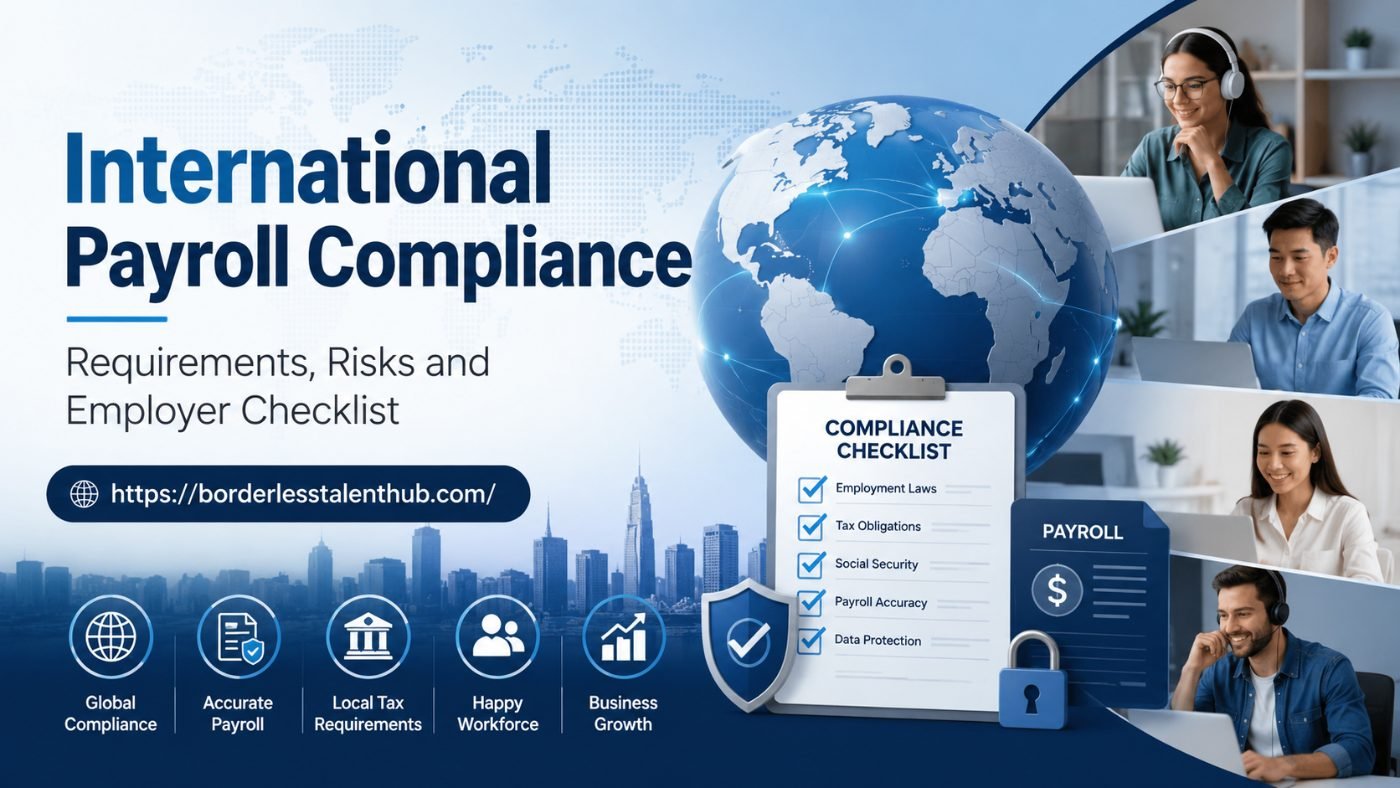
International Payroll Compliance: Requirements, Risks and Employer Checklist
Hiring international employees can give your business access to skilled remote talent, wider time zone coverage, and stronger operational flexibility. For companies in Europe, the USA, Canada, Australia, and New Zealand, global hiring is no longer only for large multinationals. Small and growing businesses are also building remote teams across borders for customer support, sales, administration, social media management, back-office support, finance admin, and specialist project work.
But once a business hires someone in another country, payroll becomes more than simply sending a monthly payment.
International payroll compliance means making sure employees are paid correctly, taxed correctly, classified correctly, and supported under the right employment structure. It involves local employment rules, tax deductions, statutory benefits, payroll records, employment contracts, working hours, leave entitlements, and ongoing compliance checks.
Getting this right matters from the start. Payroll mistakes can create financial penalties, employee disputes, tax exposure, reputational damage, and delays when scaling into new markets.
This guide explains the main international payroll compliance requirements, the risks employers should understand, and a practical checklist to follow before hiring remote employees across borders.
If your business is planning to hire internationally, Borderless Talent Hub can support you with remote staffing, Employer of Record support, payroll coordination, onboarding, compliance administration, and ongoing team support. You can explore the full service model here: Services | Borderless Talent Hub.
What is international payroll compliance
International payroll compliance is the process of paying employees who work in another country in line with local employment, tax, payroll, and statutory requirements.
This may include:
- Correctly classifying the worker as an employee or contractor
- Using the right employment structure
- Preparing compliant employment documentation
- Calculating salary, deductions, taxes, and statutory payments
- Meeting local payroll deadlines
- Keeping accurate payroll and employment records
- Managing benefits, leave, working hours, and termination rules
- Supporting ongoing compliance as laws or employee circumstances change
For example, if a UK business hires a remote employee in another country, it cannot simply treat that person as if they are based in the UK. The employee’s local employment laws may still apply, especially where they physically perform their work.
This is why international payroll should be planned before the hire is made, not after the employee has already started.
Why payroll compliance matters when hiring internationally
International hiring can move quickly, especially when a business finds the right candidate. However, payroll and compliance should never be treated as an afterthought.
A remote employee may be working from another country, but the employer still needs to understand how that person should be contracted, paid, taxed, onboarded, and managed. Different countries have different rules around employment status, probation periods, working hours, holiday pay, sick leave, social security contributions, data protection, benefits, and termination.
When payroll compliance is handled properly, the business gains structure and confidence. Employees know how they will be paid, what documents are required, who supports payroll queries, and what employment terms apply.
When payroll compliance is handled poorly, the business may face avoidable problems such as delayed payments, incorrect deductions, employee dissatisfaction, misclassification risk, and difficulty proving that the employment relationship was managed correctly.
For growing companies, compliant payroll is not only an administrative requirement. It is part of building a stable global workforce.
Key international payroll compliance requirements
1. Choose the correct hiring model
The first payroll compliance decision is how the international worker will be engaged.
Common options include:
- Hiring through your own local entity
- Hiring the person as an independent contractor
- Hiring through an Employer of Record
- Using a managed remote staffing or dedicated team model
The right model depends on the country, role, level of control, working pattern, duration of work, and whether your business already has a local legal presence.
If the worker will operate like an employee, with fixed hours, ongoing responsibilities, close supervision, and integration into your team, contractor status may not be suitable. In that situation, an Employer of Record model may be more appropriate if you do not have a local entity.
Borderless Talent Hub can help businesses understand which route fits their hiring goals through its global hiring process: How Global Hiring Works | Borderless Talent Hub.
2. Confirm worker classification
Worker classification is one of the biggest compliance risks in international hiring.
A worker may be labelled as a contractor, but local authorities may still decide they are an employee if the working relationship looks like employment in practice. This is commonly known as misclassification.
Risk factors may include:
- The person works full-time for one business
- The business controls their working hours
- The person uses company tools, systems, and processes
- The role is ongoing rather than project-based
- The person reports directly to company managers
- The person is expected to work like an internal employee
Misclassification can create tax, employment, benefit, and penalty risks. It can also damage the relationship with the worker if expectations are unclear.
Before hiring internationally, employers should decide whether the role is genuinely contractor-based or whether a compliant employment structure is needed.
3. Prepare compliant employment documents
International payroll compliance depends on clear employment documentation.
The employment contract or agreement should usually cover:
- Job title and responsibilities
- Employer or hiring structure
- Salary and payment frequency
- Currency of payment
- Working hours and location
- Holiday and leave entitlements
- Benefits and statutory rights
- Confidentiality and data protection
- Notice periods and termination terms
- Probation period, where applicable
- Local legal requirements
A generic contract copied from another country may not be suitable. Employment documents should reflect the country where the employee works and the structure being used.
Clear documentation protects both the business and the employee. It also helps payroll teams understand what needs to be paid, when, and under which terms.
4. Register and process payroll correctly
Depending on the hiring model, the employer or local employment partner may need to ensure payroll is set up correctly in the employee’s country.
This may include:
- Payroll registration
- Tax withholding setup
- Social security or equivalent contributions
- Employer payroll contributions
- Payslip generation
- Statutory reporting
- Local payroll deadlines
- Year-end or annual reporting requirements
For businesses without local payroll infrastructure, this is where Employer of Record support can reduce complexity. The business can focus on managing the employee’s work while the employment, payroll, and compliance administration are handled through the appropriate structure.
5. Understand tax and statutory deductions
Each country has its own rules for income tax, payroll deductions, social contributions, and employer obligations.
International employers need to understand:
- What must be deducted from gross pay
- What the employer must contribute separately
- Whether benefits are taxable
- How bonuses or commissions are treated
- Whether expenses can be reimbursed tax-free
- What payroll reports must be submitted
- Which deadlines apply
Incorrect tax handling can create problems for both the employer and employee. Employees may receive the wrong net pay, while the business may face back payments or penalties.
Payroll compliance is not just about paying the agreed salary. It is about ensuring the full payroll calculation is legally correct.
6. Manage benefits, leave, and local entitlements
Employee entitlements vary by country.
These may include:
- Paid annual leave
- Public holidays
- Sick pay
- Maternity, paternity, or parental leave
- Pension or social insurance contributions
- Health-related benefits
- Overtime rules
- End-of-service or termination payments
An employer cannot assume that benefits in one country are the same as benefits in another. Even if two employees perform the same role, their statutory entitlements may differ because they live and work in different countries.
This is especially important for distributed teams where employees are based across multiple regions.
7. Keep accurate payroll and employment records
Payroll records are essential for compliance.
Employers should maintain clear records of:
- Employment contracts
- Right-to-work or identity documentation, where applicable
- Salary and pay history
- Payslips
- Tax and deduction records
- Leave records
- Benefits records
- Working hours, where required
- Payroll approvals
- Changes to role, salary, or employment terms
Poor recordkeeping makes it harder to respond to audits, employee queries, internal finance reviews, or compliance checks.
For growing teams, payroll documentation should be organised from the first hire, not introduced later when the team has already expanded.
Common international payroll compliance risks
Misclassification risk
Treating a long-term employee-like worker as a contractor can lead to tax, benefit, and employment law exposure.
Permanent establishment risk
In some situations, having employees or representatives working in another country may create tax or business presence concerns. This depends on the role, authority, activities, and local rules.
Incorrect payroll deductions
If tax, social contributions, or statutory deductions are calculated incorrectly, both the business and employee can be affected.
Late or inconsistent payments
Late salary payments can damage trust and may breach local payroll rules.
Non-compliant contracts
Using employment documents that do not reflect local requirements can create disputes and legal uncertainty.
Poor benefits handling
Employees may be entitled to local leave, benefits, holidays, or statutory payments that the business did not plan for.
Weak onboarding
If payroll details, documentation, tax forms, and payment processes are not collected early, the employee’s first pay cycle may be delayed.
Lack of ongoing monitoring
Payroll compliance is not a one-time setup. Rules, employee circumstances, salary levels, benefits, and working arrangements can change.
International payroll compliance checklist for employers
Before hiring an international employee, employers should complete the following checks.
Before hiring
- Define the role, responsibilities, working hours, and reporting structure
- Decide whether the role is employee-based, contractor-based, project-based, or suitable for EOR support
- Confirm the employee’s country of work
- Review local employment and payroll requirements
- Understand likely salary, benefits, tax, and employer contribution costs
- Confirm whether your business needs local entity support or an Employer of Record model
- Set a realistic hiring budget
For support with budgeting and service options, visit Global Hiring Pricing | Borderless Talent Hub.
During offer and onboarding
- Prepare compliant employment documentation
- Confirm salary, currency, pay frequency, and start date
- Collect required employee details and payroll documentation
- Set up tax, statutory deductions, and employer contributions
- Confirm benefits and leave entitlements
- Explain payroll timelines to the employee
- Create an onboarding plan covering tools, access, communication, and reporting
After the employee starts
- Run payroll accurately and on time
- Provide payslips or payroll records where required
- Track leave, absences, and working hours where relevant
- Keep employment records updated
- Review salary changes or role changes before applying them
- Monitor compliance requirements as the team grows
- Give employees a clear contact point for payroll and HR questions
When scaling into more countries
- Review each country separately
- Avoid assuming one payroll setup works everywhere
- Standardise internal approvals and documentation
- Use consistent onboarding processes
- Keep payroll, HR, finance, and management aligned
- Consider whether a managed remote staffing or EOR model can reduce complexity
How Employer of Record support helps with payroll compliance
An Employer of Record can be useful when a business wants to hire an international employee without setting up its own local entity.
Under this model, the EOR helps handle the employment administration in the relevant country, while the client business manages the employee’s day-to-day work. This can support areas such as contracts, payroll coordination, statutory administration, onboarding, and compliance processes.
For businesses hiring across Europe, the USA, Canada, Australia, New Zealand, or other international markets, EOR support can make global hiring more practical. Instead of trying to manage every local requirement alone, the business can use a structured hiring model that supports compliant employment from the start.
This is especially helpful for companies hiring their first international employee, testing a new market, or building a remote team without opening an overseas entity.
International payroll compliance for remote teams
Remote teams often grow gradually. A business may first hire one social media manager, then add a customer support specialist, virtual assistant, sales support representative, finance admin assistant, or operations coordinator.
At first, payroll may feel manageable. But as the team grows across different countries, the complexity increases.
Each country may have different rules for:
- Payroll deductions
- Employer contributions
- Leave entitlements
- Public holidays
- Working time
- Termination
- Benefits
- Payroll reporting
This is why remote hiring should be supported by clear systems and a reliable operating model. Businesses need more than candidate sourcing. They also need onboarding, payroll coordination, compliance administration, and ongoing support after the hire is made.
Borderless Talent Hub supports businesses with remote staffing, dedicated teams, EOR support, payroll coordination, and global workforce management. If you are ready to plan your next hire, you can begin here: Get Started with Global Hiring | Borderless Talent Hub.
When should a business review its payroll compliance
A business should review international payroll compliance when:
- Hiring its first employee in a new country
- Moving a contractor into a long-term role
- Changing salary, bonuses, or benefits
- Expanding from one remote employee to a team
- Hiring across several countries
- Introducing new working hours or shift patterns
- Ending an employment relationship
- Changing the role or reporting structure
- Moving from direct hiring to EOR support
- Preparing for investment, finance review, or audit
Payroll compliance should also be reviewed if the business is unsure whether a contractor is still correctly classified. A working arrangement that was suitable at the beginning may become riskier as the role becomes more permanent and integrated into the business.
Practical employer checklist before international hiring
Use this short checklist before making an international hire:
- Have we confirmed where the employee will physically work
- Do we understand the local payroll and employment requirements
- Is the worker correctly classified
- Do we need an Employer of Record or local employment structure
- Have we calculated salary, taxes, employer costs, and benefits
- Is the employment contract suitable for the country and role
- Have we collected all payroll and onboarding documents
- Do we know the payroll deadlines and reporting requirements
- Have we explained pay frequency, currency, and deductions to the employee
- Do we have ongoing support for payroll queries and compliance changes
If the answer to any of these questions is unclear, it is better to resolve the issue before the employee starts.
Final thoughts
International payroll compliance is one of the most important parts of hiring remote employees across borders. It protects the business, supports the employee, and creates the structure needed to grow a reliable global team.
For companies in Europe, the USA, Canada, Australia, and New Zealand, global hiring can be a powerful way to access skilled talent and scale faster. But payroll, contracts, tax, benefits, classification, and compliance must be handled carefully.
The right support model can make international hiring simpler. Instead of managing recruitment, payroll, compliance, onboarding, and employee support through separate processes, businesses can use a more structured approach that keeps global workforce growth organised from the beginning.
Borderless Talent Hub helps businesses hire, onboard, pay, and support remote employees through practical global hiring solutions, including Employer of Record support, remote staffing, payroll coordination, and ongoing account support.
To discuss your hiring plans, contact the team here: Contact Us for Global Hiring | Borderless Talent Hub.
If you are a remote professional looking for international opportunities, you can also apply through Remote Jobs & Careers | Borderless Talent Hub