
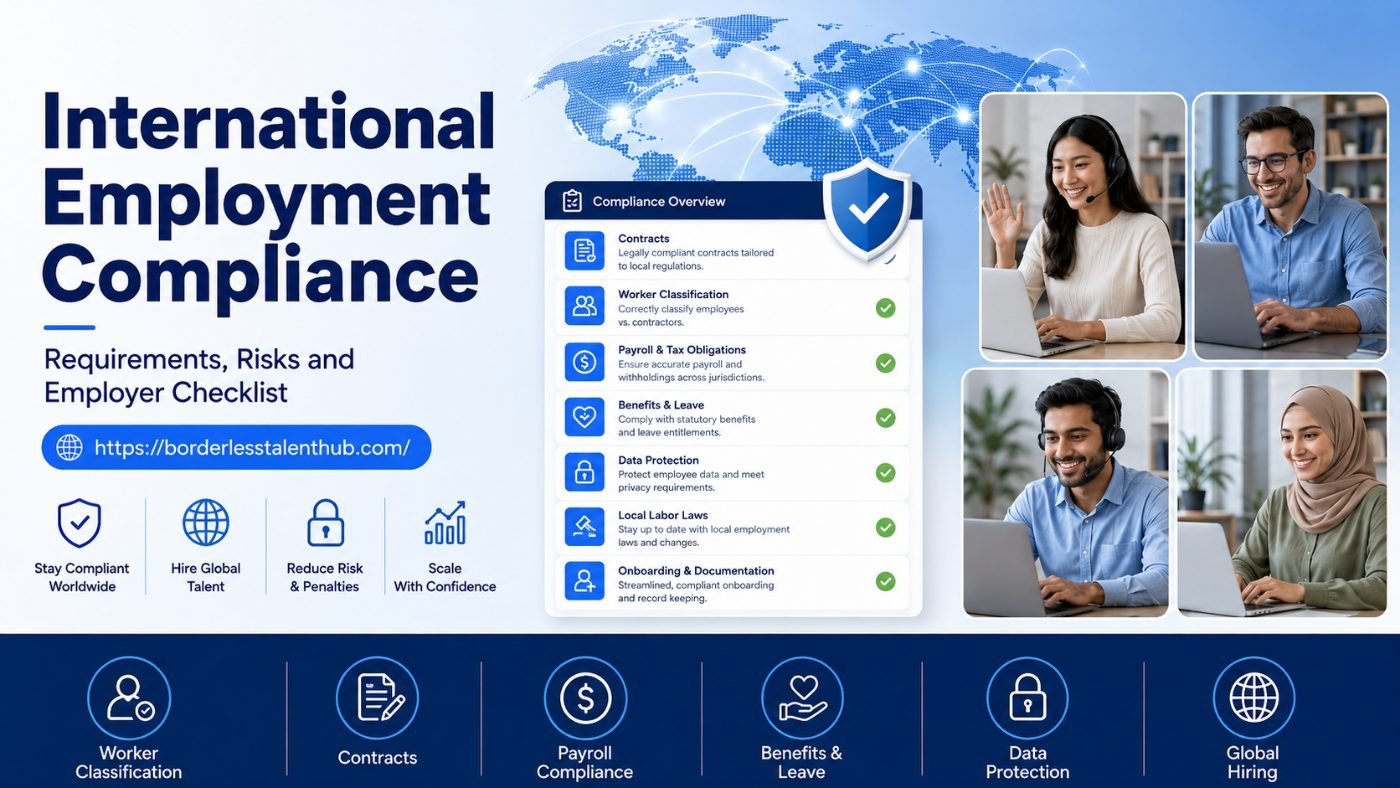
International Employment Compliance: Requirements, Risks and Employer Checklist
Hiring internationally can help businesses access skilled remote employees, reduce hiring delays, support customers across time zones, and build more flexible teams. For companies in Europe, the USA, Canada, Australia, and New Zealand, international hiring is now a practical growth option, not just something reserved for large multinational companies.
A business may want to hire a remote social media manager, customer support specialist, virtual assistant, sales support representative, finance admin assistant, operations coordinator, technical support specialist, or a wider offshore team. With the right structure, international talent can help a company scale faster and operate more efficiently.
However, hiring across borders also brings responsibility.
International employment compliance is about making sure workers are hired, paid, managed, and supported in line with the rules that apply to their employment arrangement and country of work. This can include employment contracts, worker classification, payroll, tax documentation, statutory benefits, working hours, leave entitlement, data protection, onboarding, termination processes, and ongoing recordkeeping.
If compliance is ignored, a business may face misclassification risk, payroll errors, tax exposure, employee disputes, penalties, reputational damage, and difficulties scaling into new markets.
This guide explains the key international employment compliance requirements, common risks, and a practical employer checklist to follow before hiring remote employees across borders.
Borderless Talent Hub supports businesses with remote staffing, Employer of Record support, payroll coordination, onboarding, compliance administration, and dedicated remote team solutions. You can explore the full service model here: Services | Borderless Talent Hub.
What is international employment compliance
International employment compliance means following the relevant employment, payroll, tax, documentation, and workforce rules when hiring someone who works in another country.
It is not only about paying the person correctly. It also involves choosing the right hiring model, preparing suitable employment documentation, understanding local worker rights, managing benefits, keeping records, and making sure the working relationship is structured properly from the start.
International employment compliance may include:
- Correct worker classification
- Employment contracts or service agreements
- Employer of Record support where needed
- Payroll coordination
- Tax and statutory contribution processes
- Working hours and leave rules
- Benefits and local entitlements
- Data protection and confidentiality
- Onboarding documentation
- Performance and role management
- Termination and notice processes
- Ongoing HR and compliance records
The exact requirements depend on the country, role, seniority, working arrangement, and whether the person is engaged as an employee, contractor, or through an Employer of Record model.
Why international employment compliance matters
International hiring can move quickly, especially when a business finds the right person. But if compliance is not considered early, the business may create problems that are harder and more expensive to fix later.
For example, a company may begin with a contractor arrangement because it seems simple. Over time, the person may start working full-time hours, report to a manager, use company systems, follow internal processes, and become integrated into the team. In practice, that arrangement may look more like employment than independent contracting.
Similarly, a company may agree a salary without fully understanding payroll deductions, statutory costs, local leave rules, benefits, or employer obligations in the worker’s country.
Good compliance planning helps businesses:
- Hire with more confidence
- Choose the right employment structure
- Reduce avoidable legal and payroll risk
- Build trust with employees
- Improve onboarding
- Keep payroll and HR records organised
- Scale into new markets with fewer surprises
- Protect the business from misclassification and documentation issues
For growing companies, employment compliance is not just a legal issue. It is part of building a stable and reliable global workforce.
Key international employment compliance requirements
1. Choose the correct hiring model
The first step is deciding how the international worker should be engaged.
Common options include:
- Direct employment through your own local entity
- Independent contractor engagement
- Employer of Record support
- Remote staffing or dedicated team support
- Project-based support
The right model depends on the role, country, level of control, working hours, duration of work, and whether your business has a legal entity in the worker’s country.
If the role is ongoing, closely managed, full-time, and integrated into your business, a contractor arrangement may not be the best fit. In that case, an Employer of Record model or another compliant employment route may be more appropriate.
Borderless Talent Hub helps businesses consider the right hiring structure before sourcing begins. You can read more here: How Global Hiring Works | Borderless Talent Hub.
2. Check worker classification
Worker classification is one of the biggest compliance risks in international hiring.
A worker may be called a contractor, but local authorities may look at the reality of the relationship. If the person works like an employee, the business may still face employee-related obligations.
Misclassification risk may increase where:
- The person works fixed hours
- The person works mainly or only for one business
- The company controls how the work is performed
- The role is ongoing rather than project-based
- The worker uses company systems and tools
- The worker is managed like an internal employee
- The person has no real commercial independence
- The role is central to the business operation
Misclassification can lead to tax, payroll, benefits, social contribution, holiday pay, and employment rights issues.
Before hiring, businesses should decide whether the role is genuinely independent contractor work or whether a compliant employment route is needed.
3. Prepare suitable employment documentation
International hiring needs clear documentation.
Depending on the model, this may include:
- Employment contract
- Contractor agreement
- Employer of Record documentation
- Job description
- Offer letter
- Confidentiality agreement
- Data protection terms
- Intellectual property clauses
- Remote working policy
- Equipment and systems access rules
- Onboarding checklist
- Payroll and payment details
The contract or agreement should reflect the actual working relationship. It should clearly explain the role, pay, working hours, reporting lines, notice periods, benefits, responsibilities, confidentiality duties, and termination terms.
Using a generic contract from another country can create compliance gaps. Employment documentation should be reviewed carefully and adapted to the correct hiring model.
4. Understand local employment rights
Different countries have different employment rules. These may affect:
- Minimum wage
- Working hours
- Overtime
- Paid annual leave
- Public holidays
- Sick leave
- Parental leave
- Probation periods
- Notice periods
- Termination protections
- Statutory benefits
- Pension or social security contributions
- Employment recordkeeping
A business should not assume that the rules in its home country apply to an overseas worker.
For example, two employees doing similar roles may have different leave entitlements, payroll deductions, benefits, or termination rules because they work in different countries.
This is why international employment compliance should be reviewed country by country.
5. Set up payroll correctly
Payroll is a central part of international employment compliance.
A compliant payroll setup may need to consider:
- Salary amount
- Currency
- Payment frequency
- Tax deductions
- Employer contributions
- Social security or local equivalents
- Payslips
- Payroll reporting
- Benefits deductions
- Bonus or commission treatment
- Expense reimbursement
- Payroll records
International payroll should not be treated as a simple monthly transfer. If the person is an employee, local payroll obligations may apply.
For businesses without local payroll infrastructure, Employer of Record support can provide a more practical route. Borderless Talent Hub supports payroll coordination and compliance-focused administration as part of its global hiring model. You can compare support options here: Global Hiring Pricing | Borderless Talent Hub.
6. Manage benefits and statutory entitlements
Employees may be entitled to local benefits and protections.
These can include:
- Paid holiday
- Sick pay
- Public holidays
- Parental leave
- Pension or retirement contributions
- Health-related benefits
- Social security contributions
- End-of-service payments
- Notice or severance arrangements
- Country-specific statutory payments
Benefits and entitlements should be understood before the hire is confirmed. If these costs are not considered early, the total cost of employment may be higher than expected.
A clear cost review helps businesses budget properly and avoid surprises after onboarding.
7. Protect data and confidential information
Remote employees and international workers may access company systems, client data, customer information, financial details, marketing assets, CRM records, or internal documents.
Employers should consider:
- Data access permissions
- Password and login rules
- Device security
- Confidentiality clauses
- Client information handling
- CRM and customer data access
- File-sharing rules
- Access removal when employment ends
- Data protection obligations
- Internal security training
This is especially important for remote roles involving customer support, social media management, finance admin, lead generation, technical support, HR administration, and back-office processes.
The goal is to give the employee enough access to do the role while protecting the business from unnecessary risk.
8. Create a structured onboarding process
Compliance is not only about contracts and payroll. Onboarding also matters.
A strong onboarding process should include:
- Signed documentation before the start date
- Payroll details collected early
- Role responsibilities confirmed
- Tools and systems access arranged
- Communication channels set up
- Reporting lines explained
- Working hours confirmed
- Data protection and confidentiality expectations shared
- First-week tasks agreed
- Training materials provided
- Performance expectations clarified
Remote employees should understand how they fit into the business from day one. A structured onboarding process reduces confusion and helps new hires become productive faster.
Borderless Talent Hub’s get-started process includes role planning, sourcing, onboarding, payroll coordination, compliance alignment, and support after the hire. You can begin here: Get Started with Global Hiring | Borderless Talent Hub.
Common international employment compliance risks
Misclassification risk
This occurs when a worker is treated as a contractor but the relationship looks like employment in practice. It can lead to tax, payroll, benefits, and employment rights exposure.
Payroll and tax errors
Incorrect deductions, late payroll, missing contributions, or unclear salary arrangements can create issues for both the business and the employee.
Non-compliant contracts
Using unsuitable employment documents can lead to uncertainty around rights, responsibilities, pay, notice, confidentiality, and termination.
Permanent establishment concerns
In some cases, employees working in another country may create tax or business presence questions. This depends on the role, location, activities, authority, and local rules.
Poor recordkeeping
If contracts, payroll records, leave records, approvals, and employee documents are not properly maintained, the business may struggle during audits, disputes, or internal reviews.
Data protection issues
Remote workers may access customer, employee, or business data. Weak access controls can increase confidentiality and privacy risks.
Unclear termination process
Ending an international employment relationship may involve notice periods, final pay, statutory payments, documentation, and local process requirements. This should be planned carefully.
Lack of ongoing compliance review
Compliance does not end after onboarding. Rules, salaries, roles, locations, benefits, and employee circumstances may change.
Employer checklist before hiring internationally
Use this checklist before making an international hire.
Before recruitment starts
- Define the role clearly
- Confirm whether the role is full-time, part-time, project-based, or ongoing
- Decide which country or region you want to hire from
- Review whether the role should be employee, contractor, or EOR-supported
- Estimate salary, employer costs, payroll fees, benefits, and support costs
- Confirm time zone and language requirements
- Decide who will manage the employee day to day
- Prepare the job brief and success criteria
Before making an offer
- Confirm the preferred hiring model
- Check worker classification risk
- Review local employment requirements
- Confirm payroll and statutory cost assumptions
- Prepare suitable documentation
- Decide whether Employer of Record support is needed
- Confirm start date, salary, currency, and pay frequency
- Agree working hours and reporting lines
During onboarding
- Collect required employee details
- Complete employment or engagement documentation
- Set up payroll coordination
- Confirm benefits and leave rules
- Provide access to tools and systems
- Share policies and confidentiality expectations
- Explain communication and escalation channels
- Set first-week and first-month goals
- Confirm who handles payroll and HR queries
After the employee starts
- Run payroll accurately and on time
- Keep records updated
- Track leave and working hours where required
- Review performance and role expectations
- Maintain secure access controls
- Document salary or role changes
- Monitor compliance requirements
- Keep communication regular
- Review whether the model still fits as the role evolves
International employment compliance for remote teams
Remote teams can grow quickly. A business may start with one virtual assistant or social media manager, then add customer support, technical support, finance admin, lead generation, operations, or back-office roles.
As the team grows, compliance becomes more important.
Each new country may bring different requirements around payroll, contracts, benefits, working hours, public holidays, termination, and documentation. Without a clear structure, the business may end up managing different workers in different ways, with inconsistent records and unclear obligations.
A better approach is to build a repeatable global hiring process.
This means:
- Defining roles properly
- Choosing the right engagement model
- Keeping documentation consistent
- Managing payroll clearly
- Setting onboarding standards
- Tracking compliance issues
- Reviewing team structure before scaling
- Using support where local entity or EOR requirements arise
Borderless Talent Hub helps businesses move from ad hoc international hiring to a more structured remote workforce model.
How Employer of Record support can help
An Employer of Record can help when a business wants to hire an employee in another country without setting up its own local legal entity.
This may be useful when:
- You are hiring in a new country
- You do not have a local entity
- You want a more structured employment route
- You need support with payroll and employment administration
- You want to reduce administrative complexity
- You are testing a new market
- You need to hire before entity setup would be practical
The client business typically manages the employee’s work, performance, priorities, and day-to-day activity, while the employment administration is supported through the appropriate structure.
Employer of Record support can be helpful for companies hiring across Europe, the USA, Canada, Australia, New Zealand, and other international markets where local rules and employer obligations may differ.
How much does international employment compliance support cost
The cost depends on the country, role, hiring model, salary level, benefits, payroll requirements, and whether EOR or dedicated team support is needed.
Cost factors may include:
- Recruitment and sourcing support
- Salary or monthly compensation
- Employer contributions
- Payroll coordination
- EOR support fees
- Contract and documentation support
- Benefits and statutory entitlements
- Onboarding support
- Ongoing account management
- Team scaling support
- Country-specific administration
A contractor arrangement may appear cheaper at first, but it may not be appropriate if the role functions like employment. A direct employment route may require a local entity. An Employer of Record model may add a service fee but can reduce the need to set up an entity in every market.
The right comparison is not only monthly salary. Employers should compare total cost, compliance risk, speed, admin workload, and scalability.
For pricing guidance, visit: Global Hiring Pricing | Borderless Talent Hub.
Best practices for international employment compliance
1. Plan compliance before hiring
Do not wait until the candidate has accepted the offer. Review the employment model, payroll route, documentation, and likely costs before recruitment begins.
2. Match the hiring model to the role
A short-term project may suit one model. A full-time remote employee may need another. The structure should match the reality of the working relationship.
3. Avoid generic contracts
Employment documents should reflect the country, role, working arrangement, and hiring model.
4. Keep payroll and HR records organised
Good records help with employee queries, audits, finance reviews, and future scaling.
5. Review classification regularly
A contractor arrangement can become riskier over time if the person starts working like an employee.
6. Use clear onboarding
Remote employees need clarity around tools, hours, communication, reporting, payroll, policies, and expectations.
7. Protect confidential information
Use appropriate access controls, confidentiality terms, and security processes for remote workers.
8. Review each country separately
Do not assume one country’s rules apply everywhere. Each market should be reviewed on its own.
9. Keep compliance aligned with growth
A model that works for one hire may not work for a larger team. Review the structure as the business scales.
10. Get specialist advice where needed
For complex legal, tax, immigration, or employment questions, businesses should seek advice from qualified professionals in the relevant country.
When should a business review international employment compliance
A business should review its compliance position when:
- Hiring its first employee in a new country
- Moving from contractors to employees
- Hiring without a local entity
- Scaling from one remote hire to a team
- Changing salary, benefits, or working hours
- Moving an employee to another country
- Ending an international employment relationship
- Introducing new tools or data access
- Expanding into multiple markets
- Preparing for investment, audit, or internal finance review
International employment compliance should be treated as an ongoing part of workforce management, not a one-time task.
How Borderless Talent Hub can support international employment compliance
Borderless Talent Hub helps businesses build remote teams with more structure and less operational friction.
Support can include:
- Role planning and hiring model guidance
- Remote talent sourcing and screening
- Candidate shortlisting and interview coordination
- Employer of Record support where suitable
- Payroll coordination
- Contracts and onboarding support
- Compliance-focused administration
- Dedicated remote team setup
- Ongoing workforce and account support
- Scaling support as the team grows
This gives businesses a more organised route into international hiring, especially when they want to hire remote employees without managing every compliance, payroll, and administrative detail alone.
To discuss your requirements, contact the team here: Contact Us for Global Hiring | Borderless Talent Hub.
Employer checklist for international employment compliance
Before hiring across borders, ask:
- Where will the employee physically work
- Does the business have a legal entity in that country
- Is the role suitable for contractor engagement, direct employment, or EOR support
- Are there worker classification risks
- What local employment rights may apply
- What payroll and tax processes are required
- What benefits and statutory entitlements should be budgeted for
- Is the employment documentation suitable
- Who will manage onboarding
- Who will handle payroll and HR queries
- What data and system access will the worker need
- How will leave, absences, and working hours be tracked
- What happens if the role changes
- What is the process if the employment relationship ends
- Is there a plan to review compliance as the team grows
If any of these questions are unclear, resolve them before the start date.
Final thoughts
International employment compliance is a key part of hiring remote employees across borders. It protects the business, supports the worker, and creates a stronger foundation for global growth.
For businesses in Europe, the USA, Canada, Australia, and New Zealand, international hiring can unlock skilled talent, flexible capacity, and cost-effective team growth. But it should be supported by the right contracts, payroll processes, worker classification checks, onboarding, benefits planning, and ongoing compliance administration.
The best approach is to plan early, choose the correct hiring model, keep records organised, and review compliance as the team expands.
Borderless Talent Hub supports businesses with remote staffing, Employer of Record support, payroll coordination, onboarding, compliance administration, social media management support, customer operations, back-office support, and dedicated remote team solutions.
To start planning your next international hire, visit: Get Started with Global Hiring | Borderless Talent Hub.
If you are a remote professional looking for international opportunities in support, operations, administration, finance support, sales, marketing, project coordination, or other remote-ready roles, you can apply here: Remote Jobs & Careers | Borderless Talent Hub.