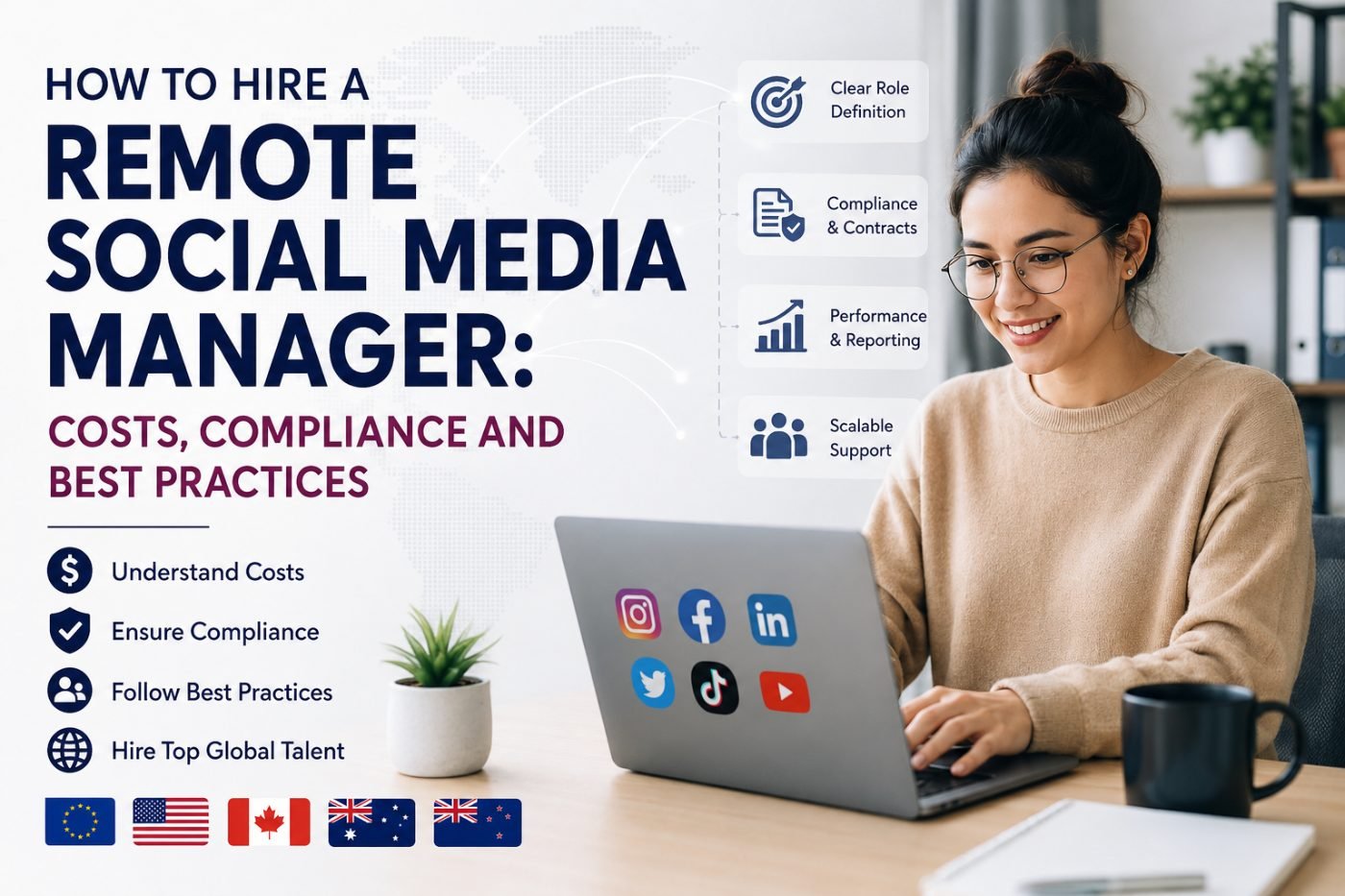
Hiring a remote social media manager can be one of the most practical ways to improve your brand visibility, publish content consistently and build stronger engagement without limiting your search to local candidates.
For businesses in Europe, the USA, Canada, Australia and New Zealand, remote hiring opens access to skilled marketing talent across different regions, time zones and cost levels. However, hiring well is not just about finding someone who can post on Instagram, LinkedIn, TikTok or Facebook. You also need to think about role scope, cost, compliance, onboarding, payroll and long-term performance.
This guide explains how to hire a remote social media manager properly, what costs to plan for, and how to avoid common mistakes when building a remote marketing function.
What does a remote social media manager do
A remote social media manager helps plan, create, publish and manage content across your business social media platforms. Depending on your needs, they may support strategy, content calendars, captions, graphics, short-form video ideas, scheduling, community engagement and performance reporting.
A strong social media manager can help with:
- Social media strategy and content planning
- Monthly content calendars
- Captions, hashtags and post copy
- Branded graphics and creative briefs
- Scheduling posts across platforms
- Responding to comments and messages
- Tracking engagement, reach and follower growth
- Supporting campaigns, launches and promotions
- Working with designers, video editors or paid ads teams
For smaller businesses, one remote social media manager may cover most of the day-to-day work. For growing businesses, the role may sit within a wider remote marketing team that includes content writers, designers, video editors, lead generation support or virtual assistants.
To explore the wider support available, visit <a href="https://borderlesstalenthub.com/services">Services | Borderless Talent Hub</a>.
Why hire a remote social media manager
Many businesses know they need better social media, but they struggle to maintain consistency. Content gets posted when someone has time, campaigns are rushed, and social media becomes reactive rather than planned.
Hiring remotely can solve this by giving your business dedicated marketing support without requiring a local full-time hire in your own country.
The main benefits include:
- Access to a wider pool of marketing talent
- More flexible cost options
- Faster hiring compared with local-only recruitment
- Support across different time zones
- Better consistency across social channels
- Scalable support as your business grows
- Ability to hire for specific skills, such as LinkedIn, TikTok, Instagram, B2B content or lead generation
A remote social media manager can be especially useful for businesses that want regular visibility but do not yet need a large in-house marketing department.
Step 1: Decide what you actually need
Before hiring, define the role clearly. “Social media manager” can mean different things depending on the business.
Some companies need someone to create simple weekly posts. Others need a more experienced person who can manage strategy, campaigns, analytics and brand positioning.
Start by answering these questions:
- Which platforms do you want to focus on
- How many posts do you need each week or month
- Do you need graphics, captions, videos or all three
- Will the person manage comments and inbox messages
- Do you need B2B content, consumer content or both
- Will they work independently or report to a marketing lead
- Do you need full-time, part-time or package-based support
- Do you need help with paid ads or organic content only
The clearer the brief, the easier it is to find the right person and avoid paying for skills you do not need.
Step 2: Choose the right hiring model
There are several ways to hire a remote social media manager. The right option depends on your budget, workload, level of control and compliance needs.
Option 1: Remote talent acquisition
This works well if you want help finding and vetting a strong candidate, but you plan to manage the working relationship yourself.
It is suitable when you already understand how to manage remote workers, handle contracts and oversee performance.
Option 2: Employer of Record support
Employer of Record support can be useful when you want to hire talent in another country but do not have a local legal entity there.
This can help with employment setup, payroll coordination, contracts and compliance administration, depending on the country and hiring structure.
For businesses hiring across borders, this is often a safer route than trying to manage international employment obligations alone.
Option 3: Dedicated remote team
If your social media needs are part of a wider growth plan, you may want a dedicated remote team rather than one individual.
For example, your team could include:
- Social media manager
- Content writer
- Graphic designer
- Video editor
- Virtual assistant
- Lead generation assistant
This model is useful when you want ongoing support across marketing, operations and customer engagement.
Option 4: Social media content package
Some businesses do not need a dedicated remote hire straight away. They may only need a fixed number of branded posts each month.
In that case, a lighter social media and content package may be more cost-effective than hiring a full-time person.
To compare available options, visit <a href="https://borderlesstalenthub.com/pricing">Global Hiring Pricing | Borderless Talent Hub</a>.
Step 3: Understand the real costs
The cost of hiring a remote social media manager depends on the person’s experience, location, workload, responsibilities and the hiring model you choose.
The main cost areas include:
1. Salary or monthly service cost
A junior social media assistant will usually cost less than an experienced social media manager who can plan campaigns, manage reporting and advise on strategy.
Costs may also vary depending on whether the role is full-time, part-time, freelance, project-based or supported through an EOR model.
2. Recruitment and screening
Finding the right person takes time. Screening should check more than CV experience. It should assess writing quality, design sense, platform knowledge, communication style and ability to work remotely.
A poor hire can cost more in the long run through missed deadlines, weak content, inconsistent posting or poor brand representation.
3. Payroll and compliance support
If you are hiring internationally, you may need support with contracts, payroll setup, employment classification and country-specific administration.
This is especially important when hiring across Europe, the USA, Canada, Australia or New Zealand, where employment rules, tax obligations and worker classification requirements can differ.
4. Tools and software
You may also need to budget for tools such as:
- Scheduling platforms
- Design tools
- Project management software
- Communication tools
- Analytics platforms
- Stock image or video resources
Your remote social media manager should be able to work inside your existing systems where possible.
5. Content production costs
Some social media managers create graphics and basic videos themselves. Others may need support from designers, editors or photographers.
Before hiring, decide whether the role includes content creation or only planning, writing and publishing.
Step 4: Do not ignore compliance
Compliance is one of the most important parts of international hiring.
If a business hires a remote worker in another country, it should consider whether the person is being engaged as an employee, contractor or through another compliant structure. Getting this wrong can create tax, payroll, employment law and administration issues.
Key compliance areas include:
- Worker classification
- Employment contracts
- Local employment rules
- Payroll and tax documentation
- Data protection and confidentiality
- Intellectual property ownership
- Working hours and leave rules
- Termination processes
- Country-specific administration
For example, a business in the UK hiring remote talent in another country may not be able to treat every remote worker as a simple contractor. The correct structure depends on the role, level of control, working pattern and local rules.
This is where global hiring support can help. Borderless Talent Hub can support businesses with recruitment, onboarding, payroll coordination, compliance administration and Employer of Record options where appropriate.
For a clearer view of the process, visit <a href="https://borderlesstalenthub.com/how-global-hiring-works">How Global Hiring Works | Borderless Talent Hub</a>.
Step 5: Write a strong job brief
A good job brief helps attract the right remote social media manager and filters out unsuitable candidates early.
Your brief should include:
- Business overview
- Target audience
- Main social platforms
- Posting frequency
- Content types required
- Brand tone and style
- Tools used by your team
- Reporting expectations
- Working hours or time zone overlap
- Required experience level
- Whether the role is full-time, part-time or project-based
Avoid vague descriptions such as “manage our social media”. Instead, explain what success looks like.
For example:
“We need a remote social media manager to plan and schedule 20 posts per month across LinkedIn, Instagram and Facebook, create branded graphics, write captions, track engagement and provide a short monthly performance report.”
That is much easier to hire for than a generic role description.
Step 6: Screen for the right skills
A strong remote social media manager should have both creative and operational skills.
Look for evidence of:
- Clear writing
- Good visual judgement
- Understanding of different platforms
- Ability to plan content calendars
- Consistent attention to detail
- Brand awareness
- Basic analytics knowledge
- Good communication habits
- Reliability when working remotely
- Ability to follow feedback
You should also ask for relevant examples of previous posts, campaigns, graphics, captions or content calendars. If the role involves strategy, ask how they would improve your current social media presence.
Step 7: Set up onboarding properly
Remote hiring works best when onboarding is structured.
Before the person starts, prepare:
- Brand guidelines
- Logo files and design assets
- Platform access
- Content examples
- Approval process
- Password and security procedures
- Monthly goals
- Reporting template
- Communication channels
- Posting schedule
A remote social media manager should understand your business, your audience and your tone of voice before publishing content.
Do not expect them to guess your brand style. Give examples of posts you like, posts you do not like and common phrases or claims to avoid.
Step 8: Agree clear KPIs
Social media performance should be measured, but not every metric matters equally.
Useful KPIs may include:
- Posting consistency
- Engagement rate
- Reach and impressions
- Follower growth
- Website clicks
- Enquiries generated
- Content approval turnaround
- Campaign performance
- Quality of comments and conversations
- Lead generation support
For B2B businesses, the goal may not only be likes or followers. A good social media manager should help build credibility, educate prospects, support recruitment, showcase services and create a stronger brand presence over time.
Step 9: Build a realistic workflow
The best remote social media managers work well when there is a clear workflow.
A simple monthly workflow may look like this:
- Agree monthly themes and priorities
- Prepare a draft content calendar
- Review captions and creative ideas
- Approve posts before scheduling
- Publish and monitor engagement
- Review performance at the end of the month
- Improve next month’s content based on results
This keeps the process organised and avoids last-minute posting.
Best practices for hiring a remote social media manager
To get better results from your hire, follow these best practices:
- Hire for communication, not just creativity
- Check writing quality carefully
- Make sure they understand your audience
- Set clear approval rules before publishing
- Give access only to the tools they need
- Use a shared content calendar
- Review performance monthly
- Keep brand guidelines simple and practical
- Start with a trial period or defined first month
- Choose the right employment or contractor structure
Remote work can be highly effective when expectations are clear from the beginning.
Common mistakes to avoid
Businesses often struggle with remote social media hiring because the role is not defined properly.
Avoid these mistakes:
- Hiring without a clear content plan
- Expecting one person to do strategy, design, video, ads and customer service without enough time
- Choosing only the cheapest option
- Ignoring compliance when hiring internationally
- Not setting approval rules
- Giving unclear feedback
- Measuring only follower numbers
- Forgetting to provide brand assets
- Failing to agree working hours and response times
A well-managed remote social media manager can add real value, but they need structure, guidance and the right tools.
When should you use Employer of Record support
Employer of Record support may be worth considering if you want to hire a remote social media manager in another country but do not have a legal entity there.
It can help reduce the administrative burden around employment setup, payroll coordination and compliance processes.
This may be useful when:
- You want to hire internationally without setting up a local company
- You need a longer-term remote employee
- You want a more structured employment arrangement
- You are unsure about local employment requirements
- You want support with onboarding and payroll administration
For many growing businesses, this creates a clearer path to hiring remote talent without building international HR infrastructure from scratch.
How Borderless Talent Hub can help
Borderless Talent Hub helps businesses hire, onboard, pay and manage global remote talent with support around recruitment, payroll coordination, compliance administration and ongoing team operations.
Whether you need one remote social media manager, a part-time content support package or a wider remote marketing team, the right structure can be matched to your stage of growth.
Borderless Talent Hub can support with:
- Understanding your hiring needs
- Defining the role and responsibilities
- Sourcing and screening remote candidates
- Shortlisting talent matched to your business
- Coordinating onboarding and documentation
- Supporting payroll and compliance administration
- Helping you scale from one hire to a wider team
To start planning your role, visit <a href="https://borderlesstalenthub.com/get-started">Get Started with Global Hiring | Borderless Talent Hub</a>.
Final thoughts
Hiring a remote social media manager can give your business the consistency, creativity and marketing support it needs to grow online. The key is to treat the hire properly from the start.
Define the role, understand the costs, choose the right hiring model, manage compliance carefully and create a clear onboarding process. With the right structure, a remote social media manager can become a valuable part of your business rather than just someone who posts content.
If you are ready to explore remote social media support or wider global hiring options, contact the team at <a href="https://borderlesstalenthub.com/contact">Contact Us for Global Hiring | Borderless Talent Hub</a>.
Candidates interested in remote opportunities can also visit <a href="https://borderlesstalenthub.com/join-us">Remote Jobs & Careers | Borderless Talent Hub</a>.