
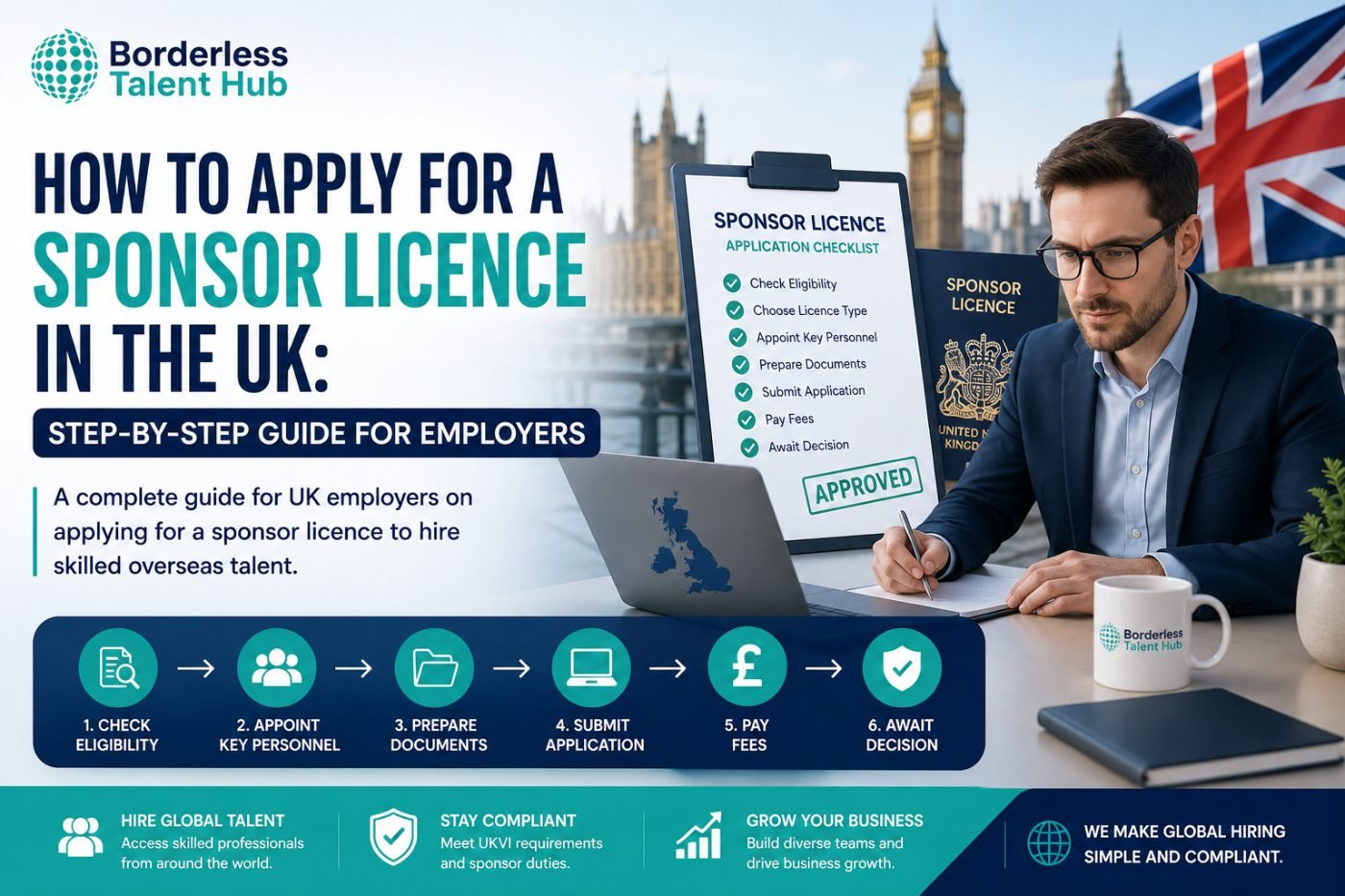
Hiring international talent can help UK employers fill skills gaps, build stronger teams and access candidates who may not be available through the local market alone.
For many businesses, the question is not whether global hiring is useful. The question is how to do it properly.
If your UK business wants to employ someone who needs visa sponsorship to work in the UK, you will usually need a sponsor licence from the Home Office. This licence allows an approved employer to sponsor eligible workers under routes such as the Skilled Worker visa.
A sponsor licence is not just an admin form. It is a serious compliance responsibility. Before applying, employers should understand the eligibility rules, prepare the right documents, appoint suitable people to manage sponsorship and make sure their HR systems can meet Home Office requirements.
This guide explains how to apply for a UK sponsor licence step by step, what employers should prepare and the mistakes to avoid.
What is a UK sponsor licence
A UK sponsor licence is permission from the Home Office for an employer to sponsor certain overseas workers. GOV.UK explains that employers usually need a sponsor licence to employ someone to work in the UK from outside the UK, including many EU, EEA and Swiss citizens who arrived after 31 December 2020. Sponsorship is not needed for some groups, such as Irish citizens, people with settled or pre-settled status under the EU Settlement Scheme, or those with indefinite leave to remain.
Once a licence is approved, the employer can use the Sponsorship Management System, usually called the SMS, to manage the licence and assign Certificates of Sponsorship where the role and worker meet the relevant rules. GOV.UK states that the SMS is used by licensed sponsors to manage licences, create and assign Certificates of Sponsorship, and report changes involving sponsored workers or the sponsor organisation.
A sponsor licence does not guarantee that a worker will get a visa. The worker must still meet the visa requirements, and the job must be suitable for sponsorship.
Who needs a sponsor licence
A UK employer may need a sponsor licence if it wants to hire a worker who does not already have the right to work in the UK and needs visa sponsorship.
This can include situations where:
- A UK business wants to hire a skilled worker from overseas
- A candidate is already in the UK but needs sponsorship to switch visa category
- An employer wants to sponsor a worker for a long-term UK-based role
- A business wants to build a UK team with international talent
- A company needs to sponsor specialist employees under a suitable work route
For remote recruitment, it is important to separate two different situations.
If someone is working remotely outside the UK for a UK company, a UK sponsor licence may not be the right route because the person may not be applying to work in the UK. However, if the worker needs to come to the UK or work in the UK under a sponsored visa route, the employer normally needs to look at sponsor licence requirements.
This is why employers should check the employment structure before starting the application. A sponsor licence is mainly about UK immigration sponsorship, not general international recruitment.
Step 1: Check whether your business is eligible
Before applying, check whether your organisation is suitable to hold a licence.
GOV.UK says employers must not have unspent criminal convictions for immigration offences or certain other crimes, such as fraud or money laundering. Employers also need systems in place to monitor sponsored workers and suitable people inside the business to manage sponsorship. UKVI may review the application and supporting documents and may visit the business to check whether it is trustworthy and capable of meeting sponsor duties.
In practical terms, your business should be able to show that it is:
- Genuine and operating lawfully in the UK
- Properly registered where required
- Able to offer genuine employment
- Able to comply with UK employment law
- Organised enough to keep accurate HR records
- Capable of monitoring sponsored workers
- Not set up mainly to facilitate someone’s immigration
This last point matters. The sponsor guidance was updated in 2026 to make clear that an application can be refused if there are reasonable grounds to consider or suspect that an organisation was established, or exists, mainly to facilitate a person’s entry or residence in the UK.
Step 2: Check whether the job is suitable for sponsorship
A sponsor licence application should be connected to real roles that can meet the relevant visa rules.
GOV.UK says a job can be sponsored only if it complies with UK minimum wage and working time regulations and meets the other criteria required for the relevant visa route. If the job does not meet the rules, the worker’s visa can be refused and the employer may lose its sponsor licence.
For a Skilled Worker licence, the employer must be able to offer work that meets the skill level and salary requirements, is genuine, and does not involve hiring the worker out to a third party for an ongoing or routine role.
Before applying, employers should prepare clear answers to questions such as:
- What role do we need to fill
- Is the occupation eligible for sponsorship
- Does the salary meet the relevant threshold and going rate
- Is this a genuine vacancy
- Where will the worker be based
- Who will manage the worker
- How does this role fit our business activity
- Are we hiring directly, or would the worker be supplied to another business
The stronger and clearer the role explanation, the easier it is to present a credible sponsor licence application.
Step 3: Choose the correct licence type
The right sponsor licence depends on the type of worker and visa route.
GOV.UK separates licences into Worker routes and Temporary Worker routes. A Worker licence is generally for skilled or longer-term employment, while a Temporary Worker licence is for specific types of temporary employment. Employers can apply for one or both types depending on their hiring needs.
For many employers hiring international staff into skilled UK-based roles, the most relevant route is usually the Skilled Worker route. A Skilled Worker licence allows employers to recruit people to work in the UK in eligible skilled occupations.
However, the correct route depends on the role. Employers should not assume that every international hire fits the Skilled Worker route. Some situations may involve Global Business Mobility, Scale-up, Creative Worker, Charity Worker, Religious Worker or another route.
Choosing the wrong licence route can create delays, extra costs or refusal risk.
Step 4: Appoint key personnel
When applying for a sponsor licence, the business must appoint people to manage sponsorship.
GOV.UK lists three main sponsorship management roles: an authorising officer, who is a senior and competent person responsible for the actions of staff and representatives using the SMS; a key contact, who acts as the main contact with UKVI; and a level 1 user, who manages the licence day to day using the SMS. These roles can be held by the same person or different people.
At least one level 1 user must usually be an employee, partner or director of the sponsor organisation and a settled worker. GOV.UK also says allocated staff must generally be based in the UK most of the time and must not have a history of non-compliance with sponsor requirements.
This step should not be treated casually. The people appointed to sponsor management roles will be responsible for important compliance actions.
Before applying, decide:
- Who will be the authorising officer
- Who will be the key contact
- Who will be the level 1 user
- Are these people suitable under the rules
- Do they understand the seriousness of sponsor duties
- Is there a backup process if someone leaves the business
Step 5: Prepare your supporting documents
The documents required depend on your organisation type and the sponsor route you are applying under.
GOV.UK’s Appendix A explains the supporting evidence employers must submit with a sponsor licence application. It also says employers should read the sponsor guidance, route-specific guidance, sponsor duties guidance, Appendix B, Appendix D and the glossary before applying.
For many businesses applying under the Skilled Worker route, GOV.UK says employers must normally submit a minimum of four documents, including any mandatory documents for their organisation type, plus additional information about the organisation and the jobs they intend to fill if granted a licence.
Common documents may include evidence such as:
- Company registration details
- Employer’s liability insurance
- VAT registration, if applicable
- PAYE registration, if applicable
- Business bank statements
- Latest accounts
- Lease or proof of business premises, if relevant
- Regulatory registration, if required for the sector
- Organisational chart
- Job descriptions for sponsored roles
- Evidence of genuine trading activity
- Explanation of why sponsorship is needed
The exact documents should always be checked against the latest Appendix A guidance before submission.
Step 6: Prepare your HR systems
A sponsor licence is not only about getting approval. It is also about keeping the licence once approved.
GOV.UK says sponsors must check that sponsored workers have the necessary skills, qualifications or professional accreditations for their jobs, only assign Certificates of Sponsorship when the job is suitable, tell UKVI if sponsored workers are not complying with visa conditions and comply with UK employment law. If sponsors do not fulfil their responsibilities, their licence may be downgraded, suspended or withdrawn.
Employers must also have HR systems that allow them to monitor immigration status, keep copies of relevant documents, record right to work checks, track attendance, keep contact details up to date and report problems to UKVI where required.
Before applying, make sure you can manage:
- Right to work checks
- Signed contracts
- Job descriptions
- Salary records
- Working hours records
- Absence and attendance
- Contact details
- Immigration status updates
- Start dates and work location
- Changes in role, salary or duties
- Reporting deadlines
- Record-keeping obligations
A weak HR setup can create problems during the application or later during a compliance check.
Step 7: Complete the online sponsor licence application
Once the business has checked eligibility, chosen the licence route, appointed key personnel and prepared documents, the next step is to apply online.
GOV.UK says employers need to apply online and, after completing the application, send the submission sheet and supporting documents if asked. Documents can be scanned or photographed and sent to the email address provided on the submission sheet, and files should be in PDF, JPEG or PNG format, clearly titled and readable. Documents not in English or Welsh must include a certified translation.
During the application, you should be ready to provide details about:
- Your organisation
- Your business activities
- Your chosen licence route
- Your key personnel
- The roles you want to sponsor
- Your HR and compliance systems
- The number of Certificates of Sponsorship you may need
- Supporting evidence for your organisation type
Take time with the application. Inconsistent details between the application form, documents, HR records and role descriptions can create unnecessary risk.
Step 8: Pay the sponsor licence fee
The sponsor licence fee depends on the type of licence and the size or status of the organisation.
Current GOV.UK fees list a Worker licence at £611 for small or charitable sponsors and £1,682 for medium or large sponsors. A Temporary Worker licence is listed at £611 for both small/charitable and medium/large sponsors. A combined Worker and Temporary Worker licence is listed at £611 for small/charitable sponsors and £1,682 for medium/large sponsors.
GOV.UK says employers must pay the licence fee themselves. The licence may be revoked if the sponsor asks the sponsored worker to pay the fee or costs linked to the application.
Small sponsors are usually organisations where at least two of the following apply:
- Annual turnover is £15 million or less
- Total assets are £7.5 million or less
- The business has 50 employees or fewer
Check the latest rules before paying, as fees and definitions can change.
Step 9: Submit documents quickly and clearly
After the online form is submitted, the submission sheet and supporting documents must be sent as instructed.
This is where some applications become delayed or refused. Documents should be clear, complete and consistent.
Practical tips:
- Use short, descriptive file names
- Send documents in the required format
- Make sure scans are readable
- Check dates and names match across documents
- Include certified translations where required
- Send documents to the correct email address
- Keep copies of everything submitted
- Make sure the authorising officer checks emails regularly
If UKVI asks for additional information, respond within the deadline given.
Step 10: Wait for the Home Office decision
GOV.UK says most sponsor licence applications are dealt with in less than 8 weeks, although UKVI may need to visit the business.
There is also a pre-licence priority service for eligible applications. GOV.UK says the priority service allows organisations to prioritise a sponsor licence application by paying an additional fee when submitting the online application, and eligible requests are considered within 10 working days. The service does not guarantee approval.
The priority service is limited and not available for every route. It may also not meet the 10-working-day timescale if mandatory documents are missing, the employer fails to respond to further information requests, or further checks are needed.
What happens if your sponsor licence is approved
If the application is approved, GOV.UK says the employer will get an A-rated licence, which allows the business to start assigning Certificates of Sponsorship. The business will also be listed on the register of sponsors.
After approval, the employer can use the SMS to manage the licence and assign Certificates of Sponsorship where appropriate.
For Skilled Worker sponsorship, there are two types of Certificates of Sponsorship:
- Defined CoS: normally for workers applying from outside the UK
- Undefined CoS: normally for workers applying from inside the UK
GOV.UK explains that if a Skilled Worker is applying for entry clearance from outside the UK, the employer must apply for a Defined CoS first and wait for approval before assigning it. If the worker is applying from within the UK, the employer normally assigns an Undefined CoS from its annual allocation.
There are also Certificate of Sponsorship fees. GOV.UK currently lists the Worker CoS fee at £525 and the Temporary Worker CoS fee at £55.
Immigration Skills Charge
For Skilled Worker and certain other routes, employers may also need to pay the Immigration Skills Charge when assigning a Certificate of Sponsorship.
GOV.UK says the Immigration Skills Charge is paid when the Certificate of Sponsorship is assigned. Current rates are £480 for the first 12 months for small or charitable sponsors and £1,320 for the first 12 months for medium or large sponsors, with additional 6-month charges after that. Employers must pay the charge themselves and may have their licence revoked if they ask the sponsored worker to pay it.
This is an important budgeting point. The sponsor licence fee is not the only cost involved in sponsoring a worker.
Common mistakes to avoid
Applying before the business is ready
A sponsor licence application should be made only when the business has the right documents, systems and people in place.
Choosing the wrong licence route
A Skilled Worker licence is not suitable for every role. Check the correct route before applying.
Weak job descriptions
The role should be clear, genuine and aligned with the business. A vague job description can make the application look less credible.
Not checking salary and skill requirements
A role may sound senior but still fail the sponsorship rules if the occupation code, salary or duties do not meet the requirements.
Poor document quality
Unreadable scans, missing translations or inconsistent information can cause delay.
Ignoring sponsor duties
Approval is only the beginning. Employers must continue meeting monitoring, record-keeping and reporting duties.
Passing costs to the worker
Employers should be very careful with sponsorship costs. GOV.UK states that sponsors must pay certain fees themselves and that asking the sponsored worker to pay can lead to revocation.
Sponsor licence checklist for employers
Before applying, check that you have:
- Confirmed your business is eligible
- Checked that the role is suitable for sponsorship
- Chosen the correct licence route
- Appointed an authorising officer
- Appointed a key contact
- Appointed a level 1 user
- Prepared your supporting documents
- Reviewed Appendix A
- Prepared role descriptions
- Checked salary and skill requirements
- Reviewed HR systems
- Prepared right to work check processes
- Set up attendance and absence tracking
- Prepared worker contact record processes
- Budgeted for licence fees, CoS fees and Immigration Skills Charge
- Checked whether priority service is suitable
- Reviewed compliance duties after approval
How Borderless Talent Hub can help employers
Borderless Talent Hub helps employers access global talent and build remote teams across the UK, Europe, USA, Canada, Australia and other international markets.
For UK employers considering sponsored recruitment, BTH can help with the practical recruitment side of the process, including role planning, candidate sourcing, screening, shortlisting and remote hiring support.
Where immigration sponsorship is involved, employers should also take advice from qualified immigration professionals or check the latest GOV.UK guidance before making decisions. Sponsor licence applications involve legal and compliance obligations, so it is important to get the process right from the start.
BTH can support employers with:
- Planning international hiring needs
- Understanding whether a remote or UK-based role is required
- Creating clear job descriptions
- Sourcing suitable global candidates
- Structuring remote team requirements
- Supporting onboarding and coordination
- Helping employers think through payroll, compliance and workforce setup
Useful internal links to add:
- Services: /services
- How It Works: /how-it-works
- Pricing: /pricing
- Resources: /resources
- Get Started: /get-started
- Contact Us: /contact-us
- Join Us: /join-us
Final thoughts
Applying for a UK sponsor licence can open the door to a wider international talent pool, but it comes with real responsibilities.
Employers need to check eligibility, confirm job suitability, choose the right licence type, appoint suitable key personnel, prepare documents carefully and build HR systems that can meet Home Office requirements.
A successful application is not just about getting approval. It is about showing that your business is genuine, organised and capable of sponsoring workers responsibly.
For employers planning to hire international talent, preparation is the most important step. Get the structure right early, understand your duties and make sure the role genuinely fits the sponsorship route.
FAQs
What is a sponsor licence in the UK
A sponsor licence is Home Office permission for a UK employer to sponsor eligible overseas workers under work visa routes such as Skilled Worker.
How long does a UK sponsor licence application take
Most applications are dealt with in less than 8 weeks, although UKVI may visit the business. Eligible employers may be able to use the priority service for a decision within 10 working days.
How much does a UK sponsor licence cost
Current Worker licence fees are £611 for small or charitable sponsors and £1,682 for medium or large sponsors. Fees can change, so employers should always check GOV.UK before applying.
Can the sponsored worker pay the sponsor licence fee
No. GOV.UK says the employer must pay the licence fee and that a licence may be revoked if the employer asks the sponsored worker to pay the fee or costs linked to the application.
What happens after a sponsor licence is approved
If approved, the employer normally receives an A-rated licence, can start assigning Certificates of Sponsorship and will be listed on the register of sponsors.
Does Borderless Talent Hub provide immigration legal advice
Borderless Talent Hub can support employers with remote recruitment, global talent sourcing and hiring coordination. For immigration legal advice or sponsor licence legal support, employers should use qualified immigration advisers or check the latest GOV.UK guidance.