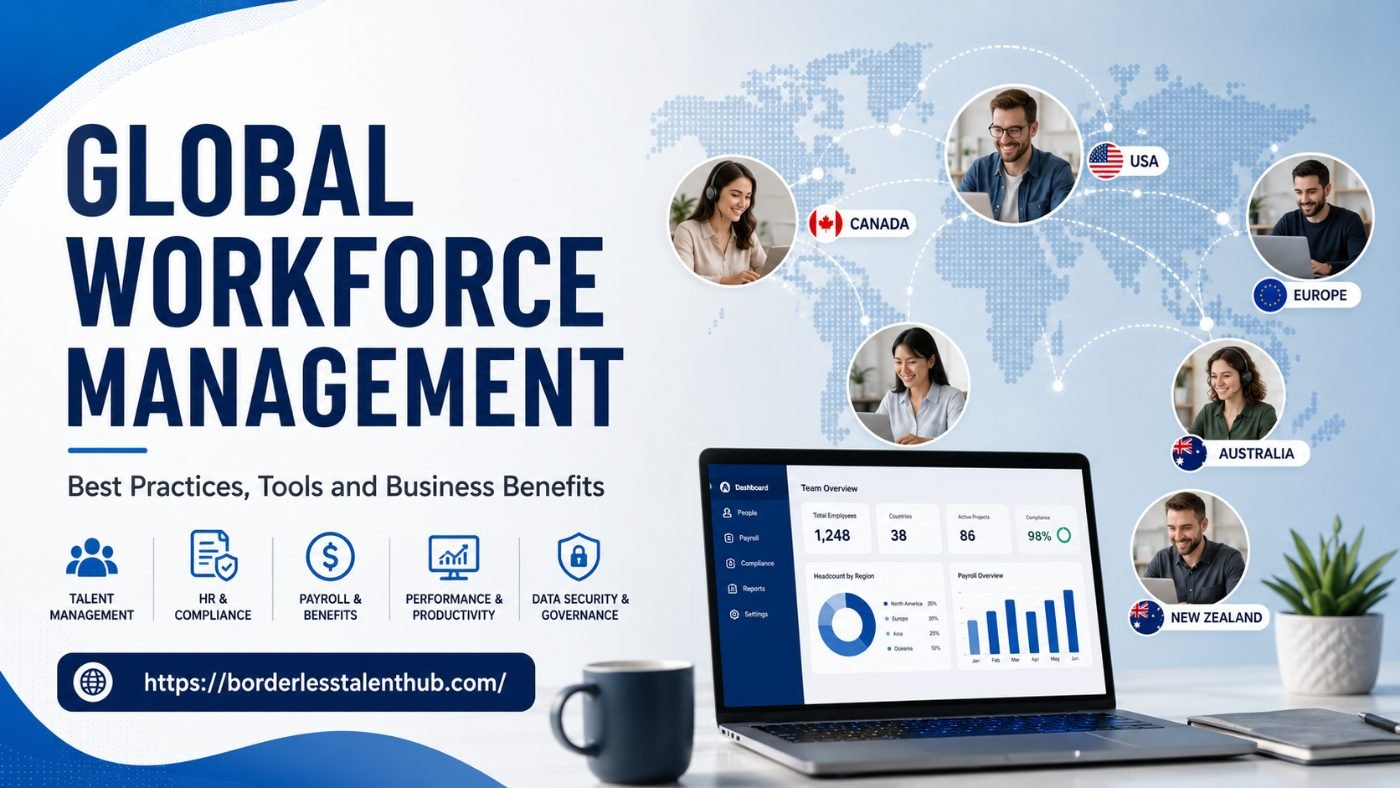
Global workforce management is becoming essential for businesses that want to hire skilled people, reduce operating complexity and build flexible teams across different countries. Whether your business is based in Europe, the USA, Canada, Australia or New Zealand, the ability to manage remote employees properly can create a major advantage.
But global hiring is not just about finding talent in another country. It also involves recruitment, onboarding, payroll coordination, compliance, communication, performance management and long-term team support. Without the right structure, a distributed team can quickly become difficult to manage.
This guide explains what global workforce management means, why it matters, which tools and processes help, and how businesses can build reliable remote teams without unnecessary risk or cost.
What is global workforce management
Global workforce management is the process of hiring, onboarding, paying, supporting and managing employees or remote team members across different countries.
It includes the systems and processes needed to keep international teams productive, compliant and aligned with your business goals.
A strong global workforce management setup may cover:
- Remote recruitment and candidate screening
- Employer of Record support
- Payroll coordination
- Employment documentation
- Compliance administration
- Onboarding and training
- Communication workflows
- Time zone planning
- Performance tracking
- HR support
- Team scaling
- Ongoing account management
For businesses that do not want to set up local entities in every country, global workforce management can provide a more practical way to access international talent while keeping operations organised.
To explore the support available, visit <a href="https://borderlesstalenthub.com/services">Services | Borderless Talent Hub</a>.
Why global workforce management matters
Remote hiring gives businesses access to a much wider talent pool. You are no longer restricted to candidates within commuting distance of your office. This can help you find social media managers, customer support specialists, virtual assistants, back-office staff, lead generation assistants, marketing support, operations staff and other remote-ready professionals.
However, global teams need structure. A business hiring across borders must think about local employment rules, contracts, payroll, working hours, communication standards, productivity and data security.
Good global workforce management helps your business:
- Hire skilled remote talent faster
- Reduce administrative pressure on internal teams
- Improve compliance when hiring internationally
- Manage payroll and documentation more smoothly
- Build consistent remote working practices
- Scale from one hire to a wider remote team
- Keep costs more predictable
- Improve team accountability and performance
Without a proper process, international hiring can become confusing, especially when several countries, time zones and employment models are involved.
Key business benefits of global workforce management
1. Access to wider talent pools
One of the biggest advantages of global workforce management is access to talent beyond your local market.
If your business needs a remote social media manager, customer support assistant, admin specialist or lead generation executive, you may find stronger or more cost-effective candidates by looking internationally.
This is especially useful for businesses that need:
- Faster hiring
- Specific skills
- Multilingual support
- Time zone coverage
- Cost-effective staffing
- Remote-first operations
- Scalable business support
A structured hiring process helps you find people who match the role, communication style, work ethic and tools used by your business.
2. Lower operating complexity
Managing international hiring alone can be time-consuming. Businesses may need to deal with contracts, payroll, documentation, local employment requirements and onboarding processes.
Global workforce management helps reduce this burden by creating a clearer operating model.
Instead of handling every detail internally, your business can use support for:
- Role planning
- Candidate shortlisting
- Contract coordination
- Payroll setup
- Compliance administration
- Onboarding support
- Ongoing HR coordination
This allows business owners and managers to focus on growth rather than administration.
3. More cost-effective growth
Opening a new office or setting up a company in another country can be expensive. For many businesses, it does not make sense to create a local entity just to hire one or two employees.
Global workforce management gives businesses a more flexible route. You can start with one remote hire, test a new market, build a small support team or scale gradually as your workload grows.
This can help reduce:
- Office costs
- Local entity setup costs
- Recruitment delays
- Internal HR workload
- Unnecessary overheads
- Long-term fixed commitments
To compare hiring models and service options, visit <a href="https://borderlesstalenthub.com/pricing">Global Hiring Pricing | Borderless Talent Hub</a>.
4. Better compliance support
Compliance is one of the most important parts of international hiring. Different countries have different rules around employment status, payroll, tax documentation, statutory benefits, working hours and termination processes.
A business hiring internationally should consider whether the person is being engaged as:
- A direct employee
- A contractor
- A remote team member
- An employee through Employer of Record support
- A project-based specialist
The right model depends on the role, level of control, working pattern, country and long-term plans.
Employer of Record support can be especially useful where your business wants to hire in a country where it does not have a local entity. It can help with employment administration, payroll coordination and compliance processes.
To understand the process, visit <a href="https://borderlesstalenthub.com/how-it-works">How Global Hiring Works | Borderless Talent Hub</a>.
5. Stronger remote team performance
A global team performs best when expectations are clear.
Good workforce management creates structure around:
- Daily responsibilities
- Reporting lines
- Communication channels
- Task ownership
- Working hours
- KPIs
- Review meetings
- Escalation routes
- Performance feedback
This helps remote employees feel connected to the business rather than disconnected from the main team.
Best practices for global workforce management
1. Start with a clear workforce plan
Before hiring internationally, define what your business actually needs.
Ask:
- Which roles do we need now
- Which roles may be needed later
- Do we need full-time, part-time or project-based support
- Which countries or time zones suit our operations
- Do we need EOR support or contractor support
- What budget range is realistic
- Who will manage the remote employee day to day
- What does success look like in the first 30, 60 and 90 days
This avoids rushed hiring decisions and helps you choose the right structure from the start.
2. Choose the right hiring model
There is no single best model for every global hire. The right option depends on your goals, budget, role type and compliance needs.
Common models include:
Employer of Record support
This may be suitable when you want to hire an employee in another country but do not have a local entity there.
Remote talent acquisition
This is useful when you need help finding and screening strong candidates but already know how you will manage the employment or contractor relationship.
Dedicated remote teams
This works well when you want to build long-term capacity across customer support, marketing, administration, sales support or operations.
Project-based support
This is useful for short-term work, temporary capacity gaps or specialist delivery needs.
Choosing the right model early helps avoid confusion around contracts, payroll, costs and responsibilities.
3. Build a structured onboarding process
Remote onboarding should be clear, organised and practical.
Before a new remote employee starts, prepare:
- Role description
- Key responsibilities
- Company background
- Brand guidelines
- Tools and login access
- Reporting structure
- Communication channels
- Security instructions
- Training materials
- First-week task list
- Performance expectations
Good onboarding helps the person understand your business quickly and reduces early mistakes.
4. Set communication rules from the beginning
Communication is one of the biggest success factors in global workforce management.
Set clear expectations around:
- Working hours
- Time zone overlap
- Meeting frequency
- Response times
- Reporting updates
- Task management
- File sharing
- Escalation process
Remote teams do not need constant meetings, but they do need predictable communication.
A simple weekly rhythm may include:
- Monday priorities
- Midweek progress check
- Friday summary
- Monthly performance review
This gives managers visibility without overwhelming the team.
5. Use clear KPIs
Every remote role should have measurable outcomes. The KPIs will depend on the role.
For a remote social media manager, KPIs may include:
- Number of posts scheduled
- Engagement rate
- Content approval turnaround
- Website clicks
- Campaign performance
- Follower growth
- Lead enquiries
- Monthly reporting quality
For a customer support specialist, KPIs may include:
- Response time
- Resolution rate
- Customer satisfaction
- Ticket quality
- Escalation accuracy
For an admin or back-office employee, KPIs may include:
- Task completion
- Accuracy
- Turnaround time
- Process improvement
- Communication reliability
Clear KPIs help remote employees understand what good performance looks like.
6. Keep payroll and compliance organised
Payroll and compliance should never be treated as an afterthought.
Businesses should keep clear records for:
- Employment or contractor agreements
- Pay rates
- Working arrangements
- Leave or absence records
- Tax or payroll documentation
- Country-specific requirements
- Confidentiality and data protection terms
- Intellectual property clauses
Where the person is hired internationally, the correct structure should be reviewed before work begins.
7. Protect company data
Remote employees may need access to business systems, social media accounts, customer records, documents or internal tools.
Data security should be part of your onboarding process.
Best practices include:
- Giving access only to necessary tools
- Using secure password sharing
- Removing access when someone leaves
- Setting clear confidentiality rules
- Limiting admin permissions
- Keeping client data controlled
- Using written processes for sensitive tasks
This is especially important for remote social media managers, customer support teams and virtual assistants who may handle accounts, messages or customer data.
8. Review and improve the process regularly
Global workforce management should improve over time.
Review:
- Which roles are performing well
- Which workflows need better documentation
- Where managers need more visibility
- Whether payroll and compliance processes are smooth
- Whether time zone coverage is working
- Whether the team needs additional support
- Whether the business is ready to scale
A good remote workforce model should become easier to manage as your systems improve.
Useful tools for global workforce management
You do not need complicated software from day one, but you do need the right categories of tools.
Avoid choosing tools only because they are popular. Choose tools that match your business size, workflow and reporting needs.
1. Communication tools
These help remote teams stay connected.
They may support:
- Team messaging
- Video meetings
- Group updates
- Quick questions
- Announcements
- Manager check-ins
The goal is to keep communication simple and searchable.
2. Project management tools
Project management tools help teams track tasks, deadlines and ownership.
They are useful for:
- Social media calendars
- Customer support workflows
- Marketing campaigns
- Admin tasks
- Sales follow-ups
- Operations projects
Every task should have an owner, deadline and clear expected outcome.
3. Payroll and HR tools
Payroll and HR tools help manage:
- Employee records
- Pay schedules
- Leave tracking
- Documentation
- Onboarding checklists
- HR administration
- Compliance records
For international hiring, these tools should fit the chosen employment or EOR structure.
4. Time and attendance tools
These may be useful when you need visibility over working hours, shift coverage or support availability.
They can help with:
- Time zone planning
- Shift management
- Attendance records
- Workload tracking
- Capacity planning
Not every remote role needs strict time tracking, but businesses should still have a clear way to measure availability and output.
5. File sharing and documentation tools
Remote teams need access to clear instructions.
Useful documents include:
- Standard operating procedures
- Brand guidelines
- Training notes
- Approval processes
- Customer service scripts
- Social media templates
- Reporting formats
- FAQs
Good documentation reduces repeated questions and helps new hires become productive faster.
6. Performance reporting tools
Performance reporting helps managers understand whether the remote team is delivering value.
Reports may cover:
- Completed tasks
- Productivity
- Campaign results
- Customer support metrics
- Lead generation activity
- Quality checks
- Monthly progress
- Issues and improvements
Good reporting should be simple, consistent and linked to business goals.
Common global workforce management mistakes
Many businesses hire internationally before they have the right structure in place.
Avoid these common mistakes:
- Hiring without deciding the correct employment model
- Treating every remote worker as a contractor
- Ignoring country-specific compliance requirements
- Using vague job descriptions
- Not setting clear KPIs
- Giving remote employees poor onboarding
- Using too many communication channels
- Forgetting data security
- Not reviewing performance regularly
- Choosing the cheapest option without checking quality
- Scaling too quickly without process documentation
Remote hiring works best when the business is organised before the person starts.
How global workforce management supports business growth
A well-managed global workforce can support growth in several ways.
It allows your business to:
- Add capacity without opening new offices
- Hire specialist talent across borders
- Support customers across wider time zones
- Build a remote marketing or operations team
- Improve service delivery
- Reduce pressure on local staff
- Keep costs more predictable
- Test new markets more easily
- Scale up or down with demand
For many businesses, the first step may be hiring one remote employee. Over time, that can grow into a dedicated team supporting marketing, customer service, administration, lead generation or back-office operations.
How Borderless Talent Hub can help
Borderless Talent Hub supports businesses with global remote hiring, Employer of Record support, payroll coordination, compliance administration and ongoing team support.
Whether your business needs one remote employee, a social media manager, a customer support specialist or a dedicated remote team, the right structure can be matched to your goals and budget.
Support can include:
- Workforce planning
- Role scoping
- Remote candidate sourcing
- Screening and shortlisting
- Interview coordination
- Contract and onboarding support
- Payroll coordination
- Compliance administration
- Ongoing account support
- Remote team scaling
To start planning your global workforce, visit <a href="https://borderlesstalenthub.com/get-started">Get Started with Global Hiring | Borderless Talent Hub</a>.
Final thoughts
Global workforce management is about more than hiring people in different countries. It is about creating a clear, compliant and practical system for finding, onboarding, paying and managing remote talent.
For businesses in Europe, the USA, Canada, Australia and New Zealand, the right workforce model can make international hiring faster, easier and more cost-effective.
The best approach is to start with a clear plan, choose the right hiring model, set strong communication standards, manage compliance carefully and review performance regularly.
If your business is ready to build or improve a global remote team, contact <a href="https://borderlesstalenthub.com/contact-us">Contact Us for Global Hiring | Borderless Talent Hub</a>.
Candidates interested in remote opportunities can visit <a href="https://borderlesstalenthub.com/join-us">Remote Jobs & Careers | Borderless Talent Hub</a>.