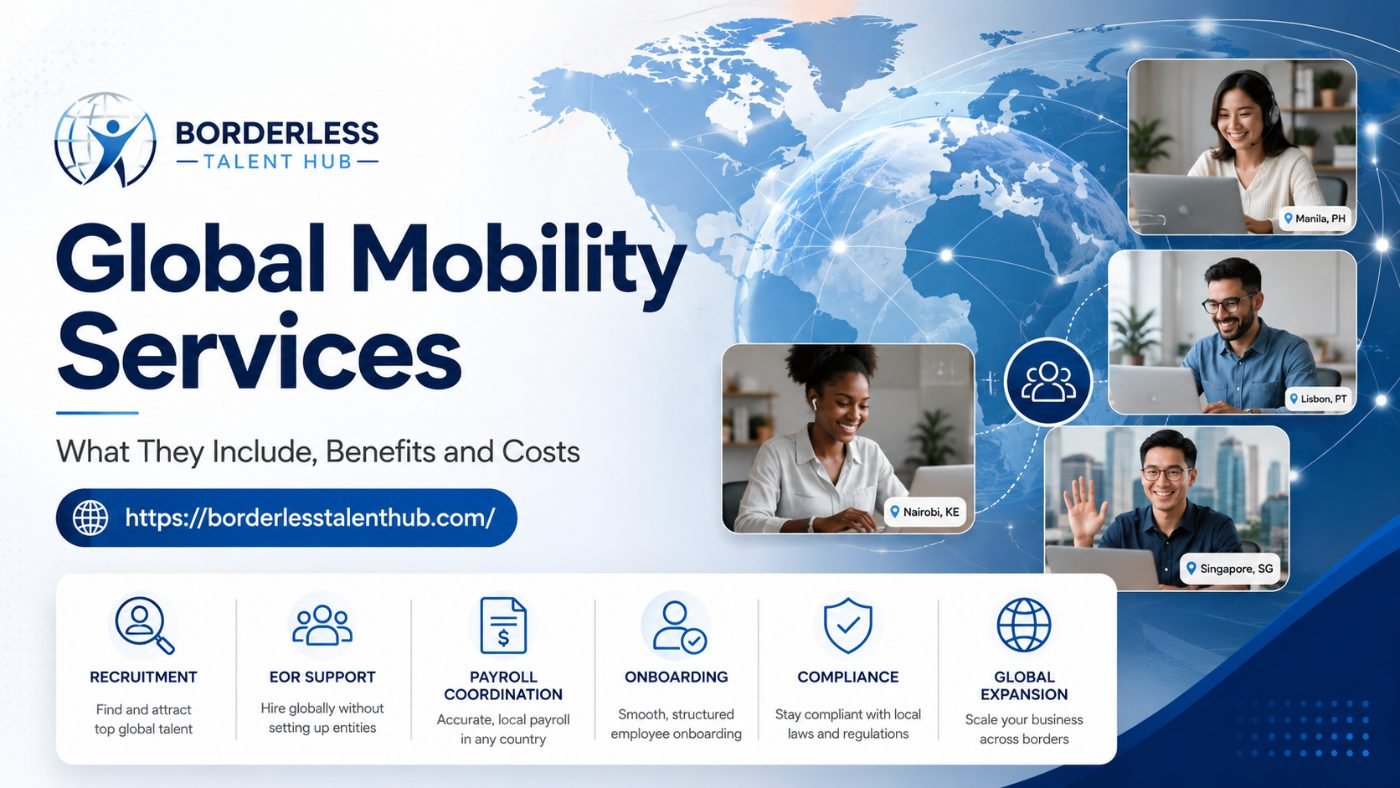
Global Mobility Services: What They Include, Benefits and Costs
Growing a business internationally no longer always means opening offices, relocating entire teams, or setting up a legal entity in every country. Many companies now build distributed teams across Europe, the USA, Canada, Australia, New Zealand, and other regions by hiring remote employees, offshore specialists, social media managers, customer support teams, back-office staff, and operational talent.
This creates a major opportunity for businesses. You can access wider talent pools, support customers across time zones, reduce hiring delays, and build a more flexible workforce.
However, international hiring also creates practical questions:
How should the employee be hired
Who manages payroll
What happens if the person works from another country
Do you need an Employer of Record
What documentation is required
How do you control costs
How do you keep the team compliant and productive
This is where global mobility services become important.
Global mobility services help businesses plan, hire, onboard, pay, support, and manage employees or workers across borders. For some companies, this may involve employee relocation. For many modern businesses, it also includes remote hiring, cross-border payroll coordination, Employer of Record support, compliance administration, workforce planning, and ongoing employee support.
In this guide, we explain what global mobility services include, the main benefits, the cost factors to consider, and how to decide whether your business needs support before hiring internationally.
What are global mobility services
Global mobility services help businesses manage employees, workers, or teams who operate across different countries.
Traditionally, global mobility often meant relocating employees from one country to another. Today, it is broader. It can include remote employees, international hires, temporary assignments, overseas contractors, Employer of Record support, payroll coordination, compliance documentation, onboarding, and cross-border team management.
For example, a UK business may want to hire a social media manager overseas. A company in Canada may need a remote customer support team in a different time zone. A business in Australia may want back-office or finance support from another country. A company in the USA may want to test a new market without opening a local entity.
In each case, the business needs more than recruitment. It needs a structure that supports hiring, payment, compliance, documentation, onboarding, communication, and long-term team success.
Borderless Talent Hub supports businesses with global remote talent, EOR support, payroll coordination, onboarding, compliance support, and dedicated remote team solutions. You can explore the full service model here: Services | Borderless Talent Hub.
What do global mobility services include
Global mobility services can vary depending on the country, role, hiring model, and level of support required. For most growing businesses, the main areas include the following.
1. Global workforce planning
Before hiring internationally, businesses need a clear workforce plan.
This includes deciding:
- Which roles are suitable for remote or international hiring
- Which countries or regions may provide the right talent
- Whether the role needs full-time, part-time, project-based, or dedicated team support
- What time zone overlap is required
- What language skills are needed
- Whether the worker should be hired as an employee, contractor, or through an Employer of Record
- What budget is realistic for salary, payroll, compliance, and management support
Good global mobility planning helps prevent rushed hiring decisions. It also reduces the risk of choosing the wrong employment structure after the candidate has already accepted the role.
If your business is still deciding the best route, the process is explained here: How Global Hiring Works | Borderless Talent Hub.
2. International recruitment and candidate sourcing
Global mobility often begins with finding the right person.
This may include:
- Creating a clear job brief
- Identifying suitable talent markets
- Sourcing candidates across different countries
- Screening for skills, experience, communication, and remote readiness
- Shortlisting suitable candidates
- Supporting interview coordination
- Helping the employer compare candidates fairly
For international hiring, candidate quality is only one part of the decision. Businesses also need to consider working style, communication habits, time zone fit, language ability, technical setup, and whether the person can work effectively in a remote environment.
This is especially important for roles such as social media managers, customer support specialists, virtual assistants, sales support representatives, finance admin assistants, and operations coordinators.
3. Employer of Record support
An Employer of Record, often called an EOR, can help businesses hire international employees without setting up their own local company in the worker’s country.
This can be useful when:
- You want to hire in a new country
- You do not have a local legal entity
- You want to reduce administrative complexity
- You need support with contracts, payroll, and employment administration
- You are testing a new market before making a bigger commitment
- You want to hire faster while keeping the structure more organised
Through an EOR-style support model, the business can focus on managing the employee’s day-to-day work, while employment administration is supported through the appropriate structure.
This can be particularly useful for companies hiring across Europe, the USA, Canada, Australia, New Zealand, and other international markets where local rules may differ.
4. Payroll coordination
Payroll is one of the most important parts of global mobility.
When a person works in another country, payroll may involve:
- Salary payments
- Local tax considerations
- Statutory deductions
- Employer contributions
- Payslip processes
- Payment frequency
- Currency considerations
- Payroll documentation
- Payroll queries and employee support
International payroll should not be treated as a simple bank transfer. If the worker is an employee, there may be local payroll rules, tax obligations, statutory contributions, and employment records to manage.
Payroll coordination helps businesses keep payment processes more organised and gives employees confidence that they will be paid accurately and on time.
For more detail on cost planning, visit: Global Hiring Pricing | Borderless Talent Hub.
5. Compliance and documentation support
Global mobility services usually include support with employment documentation and compliance processes.
This can cover:
- Employment contracts
- Onboarding documents
- Worker classification checks
- Payroll and HR records
- Leave and absence documentation
- Local employment process requirements
- Role changes and salary updates
- Termination process considerations
- Data protection and confidentiality processes
Every country has its own employment and payroll requirements. A contract or process that works in one country may not be suitable in another.
Compliance support helps businesses reduce avoidable risk and create clearer records from the beginning of the employment relationship.
Where specialist legal, tax, or immigration advice is required, businesses should seek guidance from qualified professionals in the relevant country.
6. Onboarding and remote team setup
A successful international hire needs a structured start.
Onboarding may include:
- Confirming role responsibilities
- Setting up communication channels
- Providing access to tools and systems
- Explaining reporting lines
- Sharing brand guidelines and internal processes
- Setting expectations for working hours and communication
- Introducing the employee to the wider team
- Confirming payroll timelines and key contacts
- Creating a 30-day or 90-day success plan
Remote employees should not feel disconnected from the business. The best results come when international talent is properly integrated into the company’s systems, culture, workflows, and expectations.
For roles such as social media management, customer support, admin support, and sales support, onboarding is especially important because the employee may interact directly with customers, prospects, platforms, or internal data.
7. Relocation and assignment planning
Some global mobility services may also involve relocation or temporary international assignments.
This may include:
- Planning an employee move to another country
- Reviewing assignment duration
- Understanding work location requirements
- Coordinating with local advisers where needed
- Supporting employee communication
- Considering payroll and tax impact
- Managing repatriation or return planning
Not every business needs relocation support. Many companies now prefer remote hiring or EOR-supported employment because it can be faster, more flexible, and less expensive than moving employees physically.
However, if relocation is involved, the process should be planned carefully before the move takes place.
8. Ongoing employee and workforce support
Global mobility does not stop once the employee starts.
Ongoing support may include:
- Payroll coordination
- HR and people administration
- Attendance or leave tracking
- Contract updates
- Role changes
- Performance check-ins
- Communication support
- Employee queries
- Retention planning
- Scaling into additional roles or countries
This ongoing layer is important because global teams change over time. A business may begin with one remote hire and later build a full offshore function, customer support team, social media team, or back-office unit.
A structured global mobility model helps the business scale without rebuilding the operating process every time a new hire is added.
Benefits of global mobility services
Access to a wider talent pool
Global mobility allows businesses to hire based on skills, experience, language ability, and availability rather than being limited to one local market.
This is useful when local recruitment is slow, expensive, or highly competitive.
Faster international hiring
Setting up a local entity can take time. With the right global mobility and EOR support, businesses may be able to hire internationally more efficiently and with less administrative friction.
Reduced operational complexity
Instead of managing recruitment, contracts, payroll, onboarding, and compliance through separate processes, businesses can use a more coordinated approach.
This helps internal teams stay focused on growth rather than paperwork.
Better cost control
Global mobility services can make international hiring costs clearer from the start.
Businesses can compare salary, payroll, support, and management costs before committing to a role or country.
More flexible workforce growth
Companies can start with one remote employee, then scale into a larger team as demand grows.
This is helpful for businesses that want to test a function, launch a new service, expand coverage, or build capacity gradually.
Improved employee experience
International employees need clarity around contracts, payroll, expectations, tools, communication, and support.
A structured mobility process helps employees feel more secure and better integrated into the business.
Support for market expansion
Global mobility can help companies explore new markets without immediately committing to office space, entity setup, or large fixed costs.
This is particularly useful for businesses testing demand in a new country or region.
What do global mobility services cost
The cost of global mobility services depends on the role, country, hiring model, seniority, employment structure, and level of support required.
Common cost factors include:
- Recruitment and sourcing support
- Salary or worker pay
- Employer contributions or statutory costs
- Payroll coordination
- EOR support fees
- Compliance and documentation support
- Onboarding and HR administration
- Benefits and leave entitlements
- Equipment, tools, or software access
- Ongoing account management
- Additional country-specific requirements
For example, hiring a part-time remote specialist may cost less than hiring a full-time employee through an EOR-supported structure. Building a dedicated team may have different pricing from a single specialist hire. A senior finance support role may cost more than an entry-level admin support role.
The best approach is to estimate the full cost before hiring, not just the monthly salary.
Borderless Talent Hub provides clear pricing starting points for remote specialists, EOR support, dedicated teams, social media content packages, and broader global hiring support. You can view the pricing page here: Global Hiring Pricing | Borderless Talent Hub.
Global mobility cost checklist
Before approving an international hire, employers should ask:
- What is the monthly salary or service cost
- Are there employer contributions or statutory costs
- Is payroll coordination included
- Is EOR support required
- Are contracts and onboarding documents included
- Are there any country-specific costs
- Will the employee need equipment, software, or platform access
- Is ongoing HR or people support included
- Are there additional costs for scaling the team later
- Is the pricing clear before the hire starts
This checklist helps businesses avoid comparing only salary and missing the wider cost of international hiring.
When should your business use global mobility services
Global mobility services may be useful if your business is:
- Hiring its first international employee
- Expanding into a new country or region
- Building a remote customer support team
- Hiring a remote social media manager
- Adding back-office, admin, or finance support
- Testing a new market without setting up an entity
- Moving from contractors to a more structured workforce model
- Struggling with payroll or compliance uncertainty
- Scaling from one remote hire to a full dedicated team
- Looking for a clearer way to manage global workforce growth
For many companies, the right time to seek support is before the hire is made. This allows the business to choose the right model, understand costs, and avoid correcting problems later.
Global mobility services for remote teams
Remote teams are now a major part of global mobility.
A company may never relocate an employee physically, but it may still need support with international hiring, payroll, contracts, compliance, onboarding, and long-term management.
This is especially relevant for businesses hiring:
- Social media managers
- Customer support agents
- Virtual assistants
- Sales support representatives
- Lead generation specialists
- Finance admin assistants
- HR coordinators
- Back-office staff
- Operations coordinators
- Dedicated offshore teams
These roles can often be performed remotely, but the employment setup still needs to be clear.
A remote employee should have defined responsibilities, communication expectations, payroll arrangements, reporting lines, and support channels.
How Borderless Talent Hub supports global mobility
Borderless Talent Hub helps businesses build remote teams through practical global hiring support.
This can include:
- Remote talent sourcing and screening
- Candidate shortlisting and interview coordination
- Employer of Record support where suitable
- Payroll coordination
- Onboarding and documentation support
- Compliance-focused administration
- Dedicated remote team setup
- Social media management and content support
- Ongoing workforce and account support
Whether your business needs one remote specialist or a wider dedicated team, the goal is to make international hiring more structured, practical, and manageable.
To begin planning your next hire, visit: Get Started with Global Hiring | Borderless Talent Hub.
Employer checklist for global mobility planning
Use this checklist before hiring across borders:
- Define the role clearly
- Confirm whether the role is remote, hybrid, relocated, or assignment-based
- Choose the preferred hiring country or region
- Decide whether the worker should be an employee, contractor, or EOR-supported hire
- Estimate salary, payroll, compliance, and support costs
- Confirm onboarding requirements
- Prepare employment documentation
- Decide who will manage payroll coordination
- Set communication and reporting expectations
- Plan ongoing workforce support
- Review the model before scaling into additional countries
This helps businesses move from a general hiring idea to a practical global mobility plan.
Final thoughts
Global mobility services are no longer only for large corporations moving senior employees between offices. They are now highly relevant for growing businesses that want to hire remote employees, build offshore teams, access international talent, and expand without unnecessary operational complexity.
The right global mobility support can help your business hire more confidently, manage payroll more clearly, reduce administrative pressure, and build a stronger international team.
For businesses in Europe, the USA, Canada, Australia, and New Zealand, global mobility can be a practical route to better talent, improved coverage, and more flexible growth.
Borderless Talent Hub supports businesses with remote staffing, EOR support, payroll coordination, compliance administration, social media management support, and dedicated remote team solutions.
If you are ready to discuss your global hiring plans, contact the team here: Contact Us for Global Hiring | Borderless Talent Hub.
If you are a remote professional looking for international opportunities, you can apply here: Remote Jobs & Careers | Borderless Talent Hub.